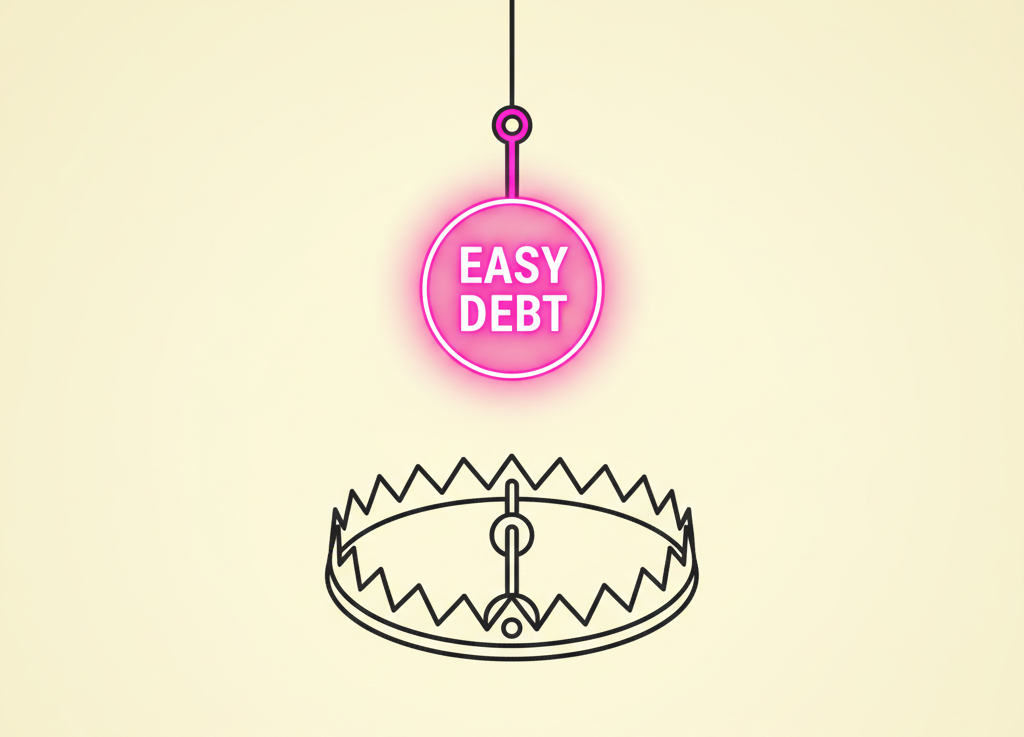
Many successful business owners share a quiet frustration. Revenue is growing, customers are loyal and the team is strong, yet business cash flow feels tighter every month. The reason is often hiding in plain sight: a stack of short-term business debt, rigid bank terms and business debt payments that consume most of the very capital meant to fuel growth.
There is a corner of the capital markets that many owners never hear about from their bank or business funding, transactional broker. Private credit, meaning direct-to-business lending from private credit funds, family offices and institutional investors has grown into one of the most significant and flexible sources of business financing available today. It looks at business cash flow and enterprise strength rather than only hard collateral, and it can be structured around the way a company actually operates. Most importantly, the capital is patient and cost effective.
This article explores how private credit works, why payback period matters the most and how business debt refinancing into a single longer-term facility can turn monthly pressure into breathing room. If any of it sounds familiar, a conversation with a Business finance advisor about exploring the private credit world is a smart next step.
Why Smart Owners Are Looking Beyond the Bank and Short-Term Business Debt Marketplace
Banks have not stopped making business loans, but many have become more selective than ever. Tighter regulation, higher capital requirements and a cautious approach to risk mean that a growing company with strong revenue can still be told "not right now". Often the reason has little to do with the quality of the business and everything to do with a checklist that favors real estate, long operating histories and spotless ratios.
At the other end of the market, opportunistic online business lenders have filled the gap with speed, but speed often comes at a steep price. Short terms, frequent payments and high effective rates can leave a business owner with capital today and a squeeze on business cash flow tomorrow.
Between these two worlds sits private credit. Private credit providers include private credit investment funds, high-net-worth family offices and institutional investors that lend directly to companies. Because they are not bound by the same capital rules as banks, they can evaluate a business more like an investor would. They look closely at business cash flow, market position, management, customer relationships and the direction the company is heading.
For many owners, this is the missing middle: business financing that is more flexible and is longer term payback like a bank and far more sustainable than short-term online business lending. It is not a last resort. For a well-run company, it can be a deliberate choice, a way to secure strategic growth capital or to complete business debt refinancing onto terms that more closely match how the company actually earns and spends money.
What a Patchwork Balance Sheet of Multiple Business Financings from Multiple Creditors Quietly Costs
Here is a curious pattern many growing companies notice: the more successful the business becomes, the more complicated its business debt can get. A bank line here, an equipment lease there, a short-term, expensive business loan to cover a large order and a short-term, expensive line of credit taken during a slow season. Each decision made sense at the time. Together, they can create a balance sheet that is hard to manage and even harder to plan around.
This patchwork carries a hidden cost. Multiple payment dates, different covenants, varied reporting requirements and overlapping liens all compete for attention. Owners end up spending valuable time tracking obligations instead of building the business. A business lender on one facility may restrict what the company can do with another, limiting options right when opportunity appears.
Recapitalization through private credit offers a cleaner path. Instead of juggling several obligations, the business replaces them with a single, unified structure and one primary capital provider. One business lender, one payment schedule and one set of terms make the balance sheet easier to read for the owner, the leadership team and any future buyer or investor.
This is not a remedy reserved for struggling companies. In many cases it is a strategic step taken by healthy businesses that have simply outgrown the business financing they assembled along the way. Consolidating higher-cost business debt into one well-structured facility can free up business cash flow that can be redirected toward sales, hiring, technology or acquisitions, the investments that actually move a company forward.
Flexible Business Financing Built Around Business Cash Flow and Cash Conversion Cycle
Traditional bank business lending tends to start with hard assets. Real estate, machinery, receivables and inventory carry the most weight, while the less tangible strengths of a company, such as its brand, intellectual property, contracts and recurring revenue and pipeline of growth opportunities often receive little credit. For service businesses, software companies and asset-light operations, this can make bank approval difficult even when the company is highly profitable.
Private credit business lenders approach the question differently. Because they underwrite the overall enterprise and its business cash flow, they can design structures that fit a specific operation rather than forcing the operation to fit a standard product.
That flexibility can show up in several ways. Some facilities include “ramp up amortizations” such as interest-only periods, which allow a company to pay only interest for a set time before principal payments begin. This can be valuable when a business is ramping up a new location, product line or major contract. Others include a Payment-In-Kind feature, often called PIK, which allows a portion of interest to be added to the principal balance rather than paid in cash during a defined growth phase. Repayment schedules can also be aligned with seasonal patterns, so payments are heavier when revenue is strong and lighter when it naturally dips.
These tools work best when used thoughtfully. PIK interest, for example, increases the balance owed over time, so it fits situations where the growth it supports is clear and measurable. A Business finance advisor can help model these options and determine which features truly serve the company. Used well, flexible structures allow business cash flow to stay invested in growth instead of being pulled out on a rigid schedule.
The Amortization Myth and the Value of a Longer Runway (Payback Period)
Many owners assume that paying principal down quickly is always the responsible choice. In some situations it might be, but generally when a growing company is required to make steep principal payments from the very first month, the result can be an amortization squeeze that drains liquidity by consuming all cash flow just when it is needed most.
Short-term online business loans are a clear example. A 12-month term means that every dollar borrowed must be repaid, with interest, within a single year. Even a solid business can find that those payments absorb much of the business cash flow the capital was meant to create.
Private credit often provides more breathing room. Terms of 24, 30 and 36-months, and up to 5-years with ABL (Asset-Backed Lines of Credit), and amortization schedules can be extended or reduced due to the flexibility of the capital. Some facilities use a "bullet" maturity, where most or all of the principal is due at the end of the term, with interest paid along the way. The business then repays the balance or completes another round of business debt refinancing at maturity, ideally from a much stronger position.
Consider the difference in monthly terms. Repaying $500,000 over 12-months requires more than $41,000 a month in principal alone, before interest. Spreading that same amount over 60 months reduces the principal portion to roughly $8,300 a month. The difference, more than $33,000 every month, stays in the business.
That retained liquidity becomes reserve capital. It can help a company navigate a slower quarter, fund a large contract, invest in equipment or act on an acquisition opportunity. A longer runway does not change the amount owed, but it can dramatically change what a business is able to accomplish while it repays.
The Real Cost of "Cheap" Bank Business Debt
A business loan from a bank with an interest rate near 9% looks inexpensive on paper. But the headline rate is only part of the story. Restrictive covenants, collateral requirements, personal guarantees, limits on additional business borrowing all carry a cost that never appears on the rate sheet.
That cost is opportunity. If a company has to pass on a $5 million contract because its bank terms leave too little working capital to fulfill it, the "cheap" business debt has quietly become very expensive. The same is true when covenant limits prevent the purchase of equipment, the opening of a new location or the hiring of key people.
Private credit lending for smaller and mid-sized companies commonly carries an all-in cost of capital currently landing in the mid-teens for cost of capital rate, depending on the size of the business, its risk profile and the structure of the deal. The headline rate is slightly higher than a bank's. However, it can be far lower than the true cost of the alternatives many owners actually face.
Equity is the clearest comparison. Bringing in an equity partner means permanently giving up a share of ownership, future profits and often some control over decisions. Private credit is business debt, not ownership. Once it is repaid, the owner keeps 100 percent of the company and all of the value created with that capital.
The right way to judge business financing is by its total impact: the rate, the fees, the terms, the flexibility and the growth it makes possible, and its effect on business cash flow. When those factors are weighed together, a well-structured private credit facility can be the more economical choice, even with a slightly higher stated rate.
A Smarter Exit From High-Cost Business Financing
Short-term business financing is designed for speed. Capital can arrive within days, which is why so many owners turn to it during a tight stretch. The trade-off is cost. These products are often priced with factor rates rather than interest rates, and once fees and short repayment periods are taken into account, the effective annual cost can reach well into the triple digits.
The repayment structure adds pressure. Over time, that steady drain on business cash flow can make it hard to cover payroll, purchase inventory or plan ahead. Some companies end up taking a second or third piece of business financing just to keep up with the first, a pattern known in the industry as “stacking”.
Business debt refinancing through private credit can offer a steadier path. Replacing costly short-term obligations with a facility currently priced in the mid-teens, with monthly payments and a multi-year term, can lower the overall cost of business borrowing and restore predictability. Instead of watching money leave the account every day, the owner can plan around a single, professional payment.
Not every company carrying short-term business debt and MCA balances will qualify right away, and timing and payoff terms matter. Typically private credit lenders will take 2 x to 3x times the risk that a bank will take as far as approval and “relationship” amount. A Business finance advisor can review the existing obligations, estimate the true cost of each and help determine whether consolidation makes sense now or after a few steps to strengthen the company's position.
The Phantom Fees Behind Traditional Business Lending
Some of the most significant costs of business borrowing never appear in the headline rate. Traditional business lending often includes appraisal fees, field audit fees, unused line fees, annual renewal fees and compensating balance requirements, where the bank asks the company to keep a minimum deposit on hand. Each charge may seem small. Together, they can raise the true cost of a facility well above what the rate suggests.
When a company works with several business lenders at once, these costs multiply. Each relationship comes with its own fees, its own reporting and its own administrative requirements. The accounting team spends time on compliance, and the owner pays for it twice: once in fees and again in lost focus.
Private credit business lenders tend to focus on the total return of the overall transaction. As a result, fee structures are often more consolidated and easier to understand, typically centered on an upfront origination fee and clearly stated terms. Consolidating business debt with a single provider also means paying one set of costs instead of several.
That said, every term sheet deserves a careful read. Private credit facilities can include prepayment provisions, exit fees or other conditions that affect the all-in cost. A Business finance advisor can compare the full cost of the current business debt against a proposed structure, line by line, so the decision is based on real numbers rather than headline rates. Over the life of a facility, savings in these soft costs can add up to thousands of dollars that stay on the bottom line.
How a Clean Capital Structure Raises Business Enterprise Value
Every owner eventually thinks about what the business might be worth to a buyer. Whether the future includes a sale to a private equity firm, a merger with a competitor or a transition to the next generation, the balance sheet will be studied closely.
Sophisticated buyers look for companies with a clean, understandable capital structure. A business carrying multiple short-term obligations, stacked MCAs or a tangle of bank covenants raises questions. Buyers may worry about hidden liabilities, business cash flow strain or the cost of unwinding complex arrangements, and those concerns often show up as a lower offer or tougher terms.
A company that has completed a private credit business recapitalization tells a different story. It has already been through thorough underwriting and due diligence by professional investors who reviewed its financials, operations and prospects before committing capital. That process does not guarantee a higher valuation, but it signals that the business is institution-ready and that ownership understands how to manage sophisticated business financing.
A single, well-structured facility is also easier for a buyer to assume, pay off at closing or replace through business debt refinancing. Clear reporting, consistent performance against covenants and a track record with an institutional business lender all add credibility. In that sense, business debt refinancing today can be part of a longer-term strategy for building enterprise value. When the time comes to sell, the capital structure becomes a strength in the conversation rather than a source of hesitation.
The Partnership Advantage in Private Credit Business Lending
In traditional banking, decisions are often made far from the business itself. A relationship manager may support the company, but final approval usually rests with a credit committee that has never visited the facility or met the team. When conditions change, the bank's policies may require it to tighten terms quickly, regardless of the company's long-term prospects.
Private credit often works differently. The people who underwrite the deal are frequently the same people who manage the relationship afterward. They know the business, understand its industry and have a direct stake in its success. That continuity can make conversations easier when a company needs to adjust a payment schedule, pursue an acquisition or work through a difficult quarter. The are asset managers whose compensation is predicated on the performance of the loan portfolio that they underwrote and financed. They have skin-in-the-game on whether your business is successful or not.
Covenants still exist in private credit, and they matter. However, they are generally negotiated to fit the specific business and its industry, functioning as sensible guardrails rather than one-size-fits-all tests. Because these business lenders accept more risk than banks, they are motivated to help their business borrowers perform well over the full term.
Many private credit providers have worked with dozens of companies facing similar challenges and opportunities. That experience can bring practical insight on everything from expansion timing to capital planning. In a volatile market, there is real value in a business lender who is willing to sit down, review the numbers and work toward a solution rather than simply enforcing the terms. The strongest private credit relationships feel less like a transaction and more like an ongoing partnership.

More Business Finance and Strategy Articles: