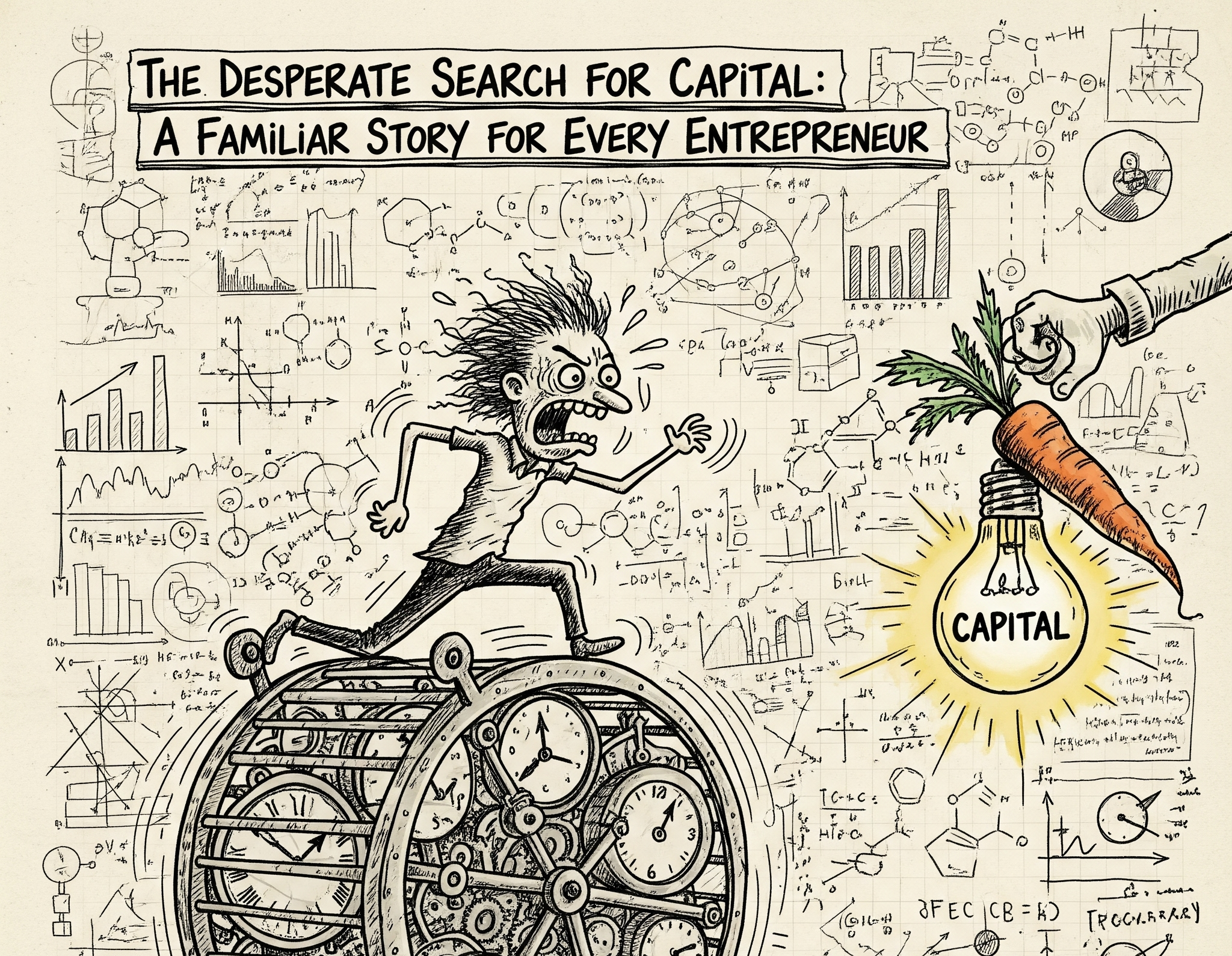
In need of business capital, but walking through a minefield? The pressure of maintaining cash flow, funding inventory, meeting payroll obligations or trying to scale can make you vulnerable, and there is an entire ecosystem of financial vultures waiting to exploit that exact vulnerability. They smell your stress from a mile away, and they mask their predatory intentions behind polished websites, friendly phone calls and the false promise of "fast, hassle-free funding."
The truth is brutal: the transactional business funding broker is not your friend, they are not your partner and they do not care if your business survives the next six months.
They are commission-hungry middlemen whose entire business model relies on trapping you in high-interest, short-term debt that lines their pockets while slowly choking your operations to death. How does your funding broker get paid?
To them, your business is not a dream or a legacy, it is merely a transaction to be milked for the absolute maximum commission before they vanish into the shadows to hunt their next victim.
To protect the Company you have poured your blood, sweat, and tears into, you must learn to see through the lies. You must understand the predatory mechanics of the transactional funding broker, expose the toxic conflict of interest that drives their every recommendation, and discover why a dedicated business finance and strategy advisor is the only true ally you can trust to sit on your side of the table.
The Devastating Myth of the Helpful Funding Broker
The modern transactional business funding broker is a master of deception. They enter your professional life pretending to be a savior, utilizing highly engineered marketing pitches designed to exploit your anxiety during tight financial times. They promise "exclusive access" to a vast network of private lenders, claiming they can negotiate terms you could never secure on your own. They speak with an artificial warmth, reassuring you that they "understand the hustle" of small business owners and want nothing more than to see you succeed.
This entire persona is a calculated, manufactured lie designed to lower your defenses. In reality, these brokers do not possess any secret, proprietary relationships, nor do they hold any special leverage over commercial lenders. They are glorified telemarketers armed with basic CRM software, mass-emailing your sensitive financial data to dozens of high-interest alternative lenders simultaneously.
They do not care about your business model, your long-term goals, or the viability of your industry; they only care about finding a lender willing to approve any amount of cash so they can trigger their payout.
By trusting these smooth-talking middlemen, business owners unwittingly hand over the keys to their financial house to an entity whose goals are diametrically opposed to their own survival. The broker’s goal is to close the deal as fast as humanly possible, regardless of the destruction left in their wake. Once the contract is signed and the funds hit your account, the broker’s phone goes silent.
They do not stick around to help you manage the business debt, nor do they care when the withdrawals begin to drain your operating account to zero. They have already collected their bounty, leaving you to deal with the wreckage alone.
The Parasitic Reality of the Commission-Driven Broker
To fully comprehend the danger a transactional broker poses, you must look directly at how they get paid. These brokers are not independent consultants, nor are they salaried professionals bound by a fiduciary duty to look out for your best interests. They are 1099 independent contractors and commission-only sales agents for the alternative lending industry. They are paid exclusively by the very lenders they steer you toward, meaning their entire livelihood is funded by maximizing the cost of the capital you receive.
This structure creates a deeply parasitic relationship. Since the broker’s fee is directly tied to the interest rate, factor rate and total volume of the loan they sell you, they are financially incentivized to make your business debt as expensive and burdensome as possible. If a broker presents you with a relatively affordable, structured SBA loan and a toxic, high-cost Merchant Cash Advance, they will actively steer you toward the MCA.
Why? Because the SBA loan might pay them a modest fee (2.0% or less) after months of rigorous underwriting, while the predatory MCA pays them a massive double-digit commission right at funding.
This is a fundamental conflict of interest that cannot be negotiated away or ignored. When a broker tells you they have found the "perfect option" for your company, what they actually mean is they have found the option that yields the highest commission payout for themselves. The business owner, operating under the naive assumption that the broker is a neutral matchmaker, walks directly into a financial trap designed by the lender and sold by the broker to maximize their mutual profit.
How Brokers Engineer the Downward Spiral of Debt
The most destructive weapon in the transactional broker's arsenal is the short-term, high-cost financial product, most notably the Merchant Cash Advance (MCA) and short-term weekly or daily repayment business loans. These products are designed to bypass traditional banking regulations, allowing lenders to charge interest rates that are highly illegal under commercial usury laws. Because these toxic products require almost no underwriting and can be funded in a matter of hours, they are the preferred tool of the predatory business funding broker.
Brokers intentionally steer desperate business owners toward these products, knowing full well that they are engineered to create a terminal debt spiral. Because these loans require daily or weekly automatic withdrawals directly from your operating bank account, they immediately destroy your business cash flow and liquidity. Within weeks of receiving the funding, the business owner find themselves unable to pay vendors, meet payroll, or purchase raw materials because the broker’s lender is sweeping their account every single morning.
THE PREDATORY DEBT CYCLE
1. Cash Flow Stress
2. Broker Pushes High-Cost, Daily-Repayment
3. Weekly (or Daily) Sweeps Drain Operating Bank Account
4. Severe Working Capital Shortage
5. Broker Returns to "Stack" a Second, More Expensive MCA
6. Total Operational and Financial breakdown occurs
When the business inevitably begins to choke under the weight of these aggressive payments, the predatory broker does not offer help. Instead, they reappear like vultures circling a dying animal, offering to "stack" a second or third advance on top of the first one.
They frame this as a life raft to help you get through the week, but in reality, it is a lead weight that guarantees your sinking. They extract multiple commissions from your compounding misery, repeatedly refinancing your balances and charging fees on top of fees until your business is driven directly into bankruptcy.
The Poisonous Mathematics of Factor Rates and Hidden Fees
One of the primary ways transactional brokers manipulate business owners is through the deliberate obfuscation of financial terms. They rarely use the standard term "Annual Percentage Rate" (APR) because doing so would expose the sheer immorality and sometimes criminality of the products they sell. Instead, they use highly misleading terminology like "factor rates," "buy rates," or "simple cost of capital."
For instance, a broker will enthusiastically tell you that you are getting a $100,000 advance with a "factor rate of 1.25." They will paint this as a cheap, flat 25% fee, making it sound highly reasonable to a stressed owner. What they deliberately hide is the structure of the repayment. If that $125,000 must be paid back via daily sweeps over a short five-month period, the actual annualized APR is not 25%, it is frequently north of 120%.
Furthermore, brokers routinely conceal a laundry list of predatory fees within the fine print of the contracts they shove in front of you. They charge exorbitant "origination fees," "admin fees," "broker fees," and even "processing fees" that are deducted directly from the principal before you ever see a dime. In many cases, you are paying interest on money you never actually received, all while the broker uses those deducted fees to fund their next luxury vacation.
Maximum Loan Size: The Golden Noose Around Your Neck
A transactional funding broker’s favorite sales tactic is to brag about the massive amount of money they can get approved for your business. They will call you in a state of manufactured excitement, shouting that they have secured a "maximum approval limit" of hundreds of thousands of dollars more than you originally requested. They frame this as a massive victory, attempting to flatter your ego by telling you that the lenders "love your business profile" and want to back you fully.
Do not fall for this psychological trap. The broker is not trying to give you more runway; they are trying to fit you for a larger golden noose. Lenders pay brokers a commission based on a direct percentage of the total funded loan amount. A $400,000 loan pays the broker exactly double the commission of a $200,000 loan, regardless of whether your business actually needs the extra capital or has any realistic ability to service that level of debt.
Pushing excessive, high-interest capital onto a healthy small business is a form of corporate sabotage. When you borrow more than you need at astronomical rates, you are transferring your future profitability directly into the hands of the lenders and the broker. Your operational margins are completely consumed by interest payments, leaving you unable to reinvest in your business, hire key personnel, or weather economic downturns. The broker does not care about this over-leveraged state; they have already pocketed their inflated commission and are completely insulated from your impending financial ruin.
The Strategy Advisor: An Invaluable Shield Against Financial Ruin
To survive the predatory traps laid by transactional brokers, you must completely change how you seek capital. You must replace the commission-hungry middleman with a dedicated professional who actually sits on your side of the table: a business finance and strategy advisor. A strategic business advisor does not view your company as a quick payday; they view it as an ecosystem that requires careful, analytical nurturing to return to its full potential.
A strategic advisor acts as an outsourced, institutional CFO for your business. They do not begin the relationship by pitching a specific loan product or rushing you to sign a contract. Instead, they begin with a deep, exhaustive analysis of your actual operational health. They dissect your balance sheet, evaluate your profit margins, map out your historical cash flows and pressure-test your growth assumptions. They work to understand the root cause of your cash need, recognizing that sometimes, the solution is not more debt, but operational restructuring, inventory optimization or expense management.
When business debt is the appropriate solution, a strategic advisor acts as your aggressive, highly skilled navigator in the business capital markets. They do not let predatory lenders dictate terms. Instead, they package your financials professionally, write a compelling strategic growth narrative, and present your business to legitimate, low-cost institutional lenders. They manage the competition among capital providers, forcing them to compete for your business, pushing for long-term amortizations (payback), and stripping away predatory covenants before you ever sign a document.
True Alignment: The Success-Based Compensation Model
The fundamental difference that separates a strategic business finance advisor from a predatory transactional broker is the structure of their compensation. A strategic advisor operates under a transparent, client-paid model that aligns their financial success directly with the health and long-term viability of your business. They do not accept hidden back-end kickbacks, double-dipping commissions, or secret finder's fees from lenders.
A strategic advisor’s compensation is strictly success-based and paid directly by you, the client. They only receive their fee when they successfully secure financing that is highly desirable, affordable, helpful, and structurally beneficial to your company. If a lender offers a terms sheet that is predatory, carries toxic personal guarantees, or threatens to choke your daily cash flow, the advisor is incentivized to advise you to reject it. Their reputation and their payment rely entirely on your long-term operational success.
This absolute alignment of incentives completely changes the relationship dynamic. Because the advisor is on your side of the table, not the lender's, they work exclusively for you. They have no incentive to rush you into a bad deal, stack multiple loans or hide predatory terms in the fine print. They are willing to take the time to clean up your balance sheet, resolve outstanding liability arrears or improve your credit profile so you can qualify for the absolute lowest-cost capital available in the market. With a business finance and strategy advisor, you finally have a sophisticated financial advocate fighting for your bottom line.
Prioritizing Cash Flow and Debt Service over Reckless Borrowing
When a transactional broker looks at your bank statements, they only see one thing: gross deposits. They do not care about your expenses, your operating margins, or your net profit. If they see $100,000 in monthly deposits, they will immediately tell a lender that you can afford a daily withdrawal of $1,500, completely ignoring the fact that you might have $95,000 in monthly operating costs. This reckless disregard for cash flow is why businesses working with brokers collapse so rapidly.
A strategic advisor operates with a deep respect for cash flow. They know that your gross revenue is a vanity metric; net cash flow and your Debt Service Coverage Ratio (DSCR) are the metrics that determine whether your business lives or dies. Before they allow you to take on a single dollar of debt, they will conduct a rigorous cash flow analysis, modeling exactly how the proposed debt service payments will impact your daily, weekly, and monthly operating liquidity.
An advisor will stress-test your business against a variety of negative scenarios:
What happens to your debt service ability if your primary vendor increases prices by 15%?
What happens if a major client delays AR payments by thirty days?
What happens if there is a sudden, seasonal dip in revenue?
By ensuring your DSCR remains at a highly healthy level (typically 1.25x or higher), the advisor solves for your business retaining a strong protective buffer. This analytical rigor ensures that you never take on business debt that requires you to operate in a constant state of emergency, preserving the vital liquidity you need to run your daily operations peacefully and profitably.
Bypassing the Gatekeepers to Access Genuine Capital Markets
The transactional broker’s network is incredibly narrow, consisting almost entirely of high-interest, non-bank alternative lenders, MCA syndicates and predatory short-term business loan lenders. They focus on these entities because they pay the highest commission rates and have virtually no regulatory oversight. They will actively keep you away from traditional commercial banks, SBA lenders, and regional credit unions because those institutions refuse to pay the corrupt, back-end finder's fees that brokers demand.
By allowing a broker to gatekeep your financing search, you are completely cut off from the most affordable, secure, and supportive capital markets in the world. You are forced to compete in a high-cost ghetto of alternative lending, paying triple-digit interest rates while healthy competitors down the street are securing traditional bank lines of credit at “low-teens, mid-twenties” APRs.
A strategic finance advisor opens the doors to the entire global capital ecosystem. Because they do not rely on lender kickbacks, they are completely free to search every corner of the commercial finance landscape.
Business finance advisors maintain direct, professional relationships with local and regional commercial banks, elite SBA underwriters, non-profit community development financial institutions (CDFIs), and institutional private credit providers and asset-based lenders. They know exactly which institutions have an appetite for your specific industry, which SBA lenders are processing loans the fastest, and how to structure your application to meet their rigorous underwriting guidelines. This deep market intelligence allows you to bypass the predatory gatekeepers and access the clean, low-cost capital your business deserves.
Taking Back Control of Your Company’s Financial Destiny
When your small or medium-sized business is facing a capital shortfall, the temptation to take the path of least resistance is incredibly high. The transactional funding broker relies on your exhaustion and fear, hoping you will sign their toxic contracts just to make the immediate pressure go away. But yielding to that temptation is an act of financial surrender. It is an agreement to hand over your future profits, your hard-earned equity, and your operational peace of mind to a group of unaligned financial predators.
Choosing a business finance and strategy advisor is an act of defiance. It is a declaration that your business is not a transactional commodity to be exploited, but a valuable asset that deserves professional, strategic advocacy. By bringing a business finance and strategy advisor to your side of the table, you instantly level the playing field against lenders, strip away the hidden traps of alternative financing, and secure capital that acts as a launchpad for sustainable growth rather than an anchor dragging you down.
You have sacrificed too much, worked too many long hours, and taken on too much personal risk to let a predatory, commission-chasing broker destroy what you have built. Demand absolute transparency. Demand uncompromised alignment. Partner with a strategic advisor who is fully committed to your long-term victory, and take back absolute control of your company's financial destiny today.