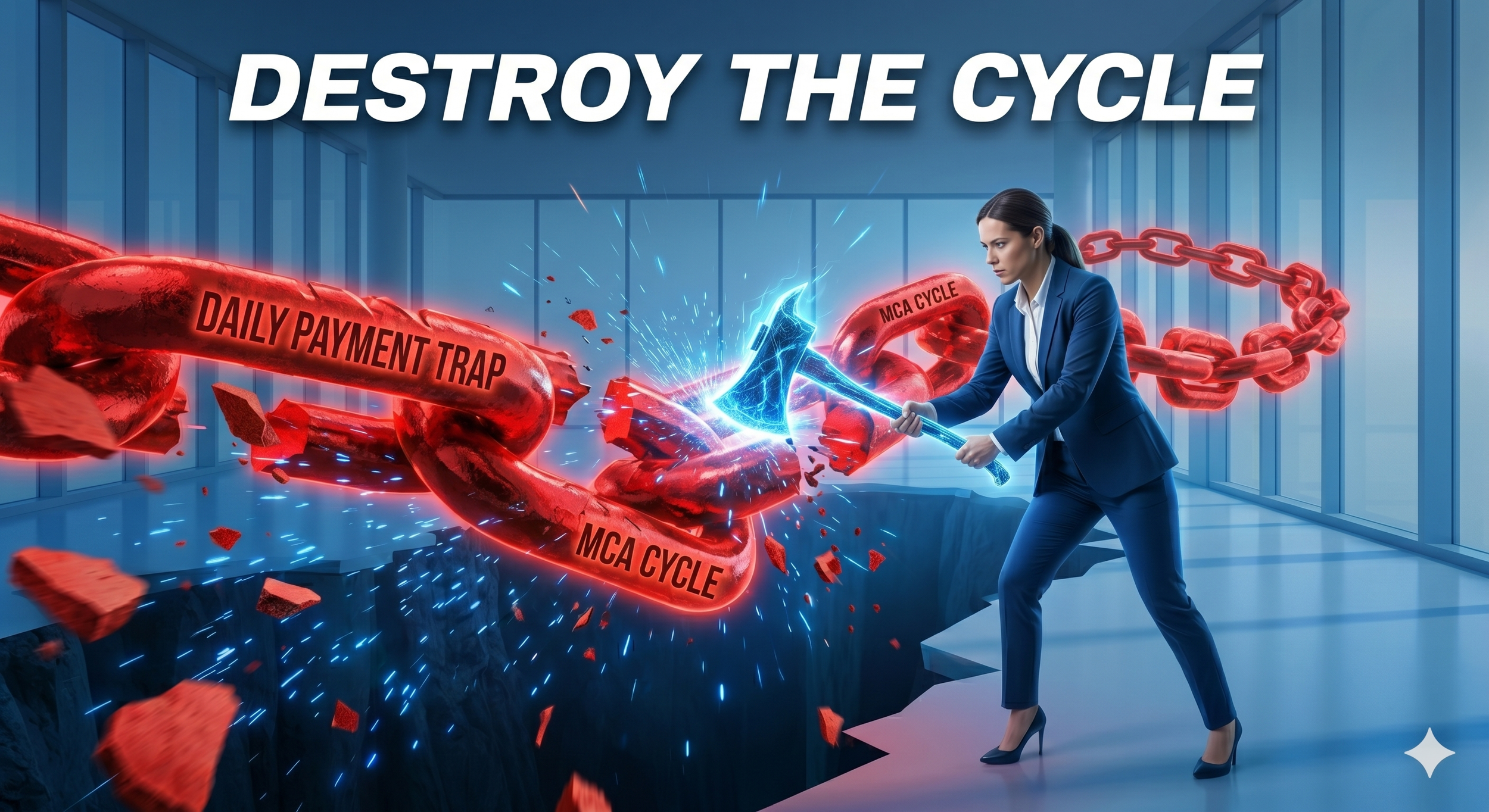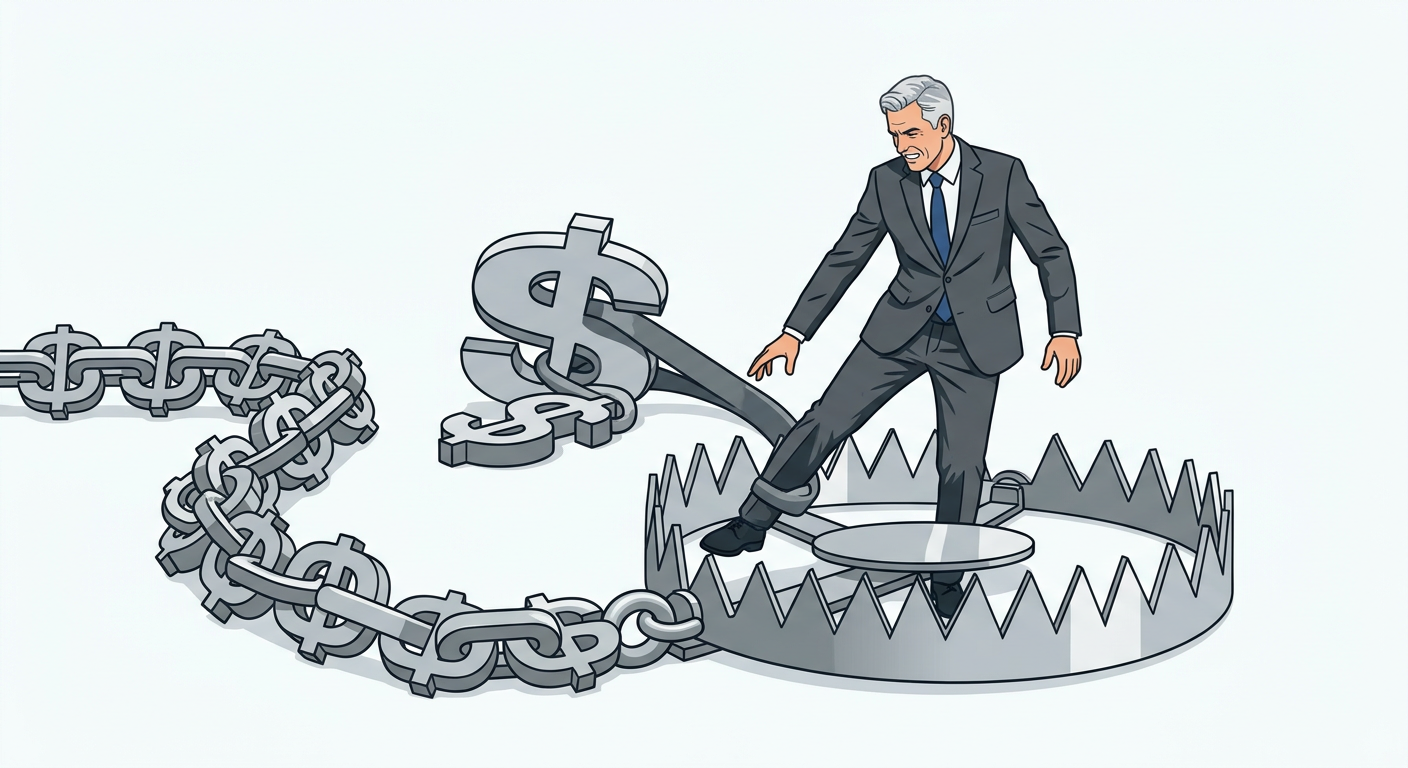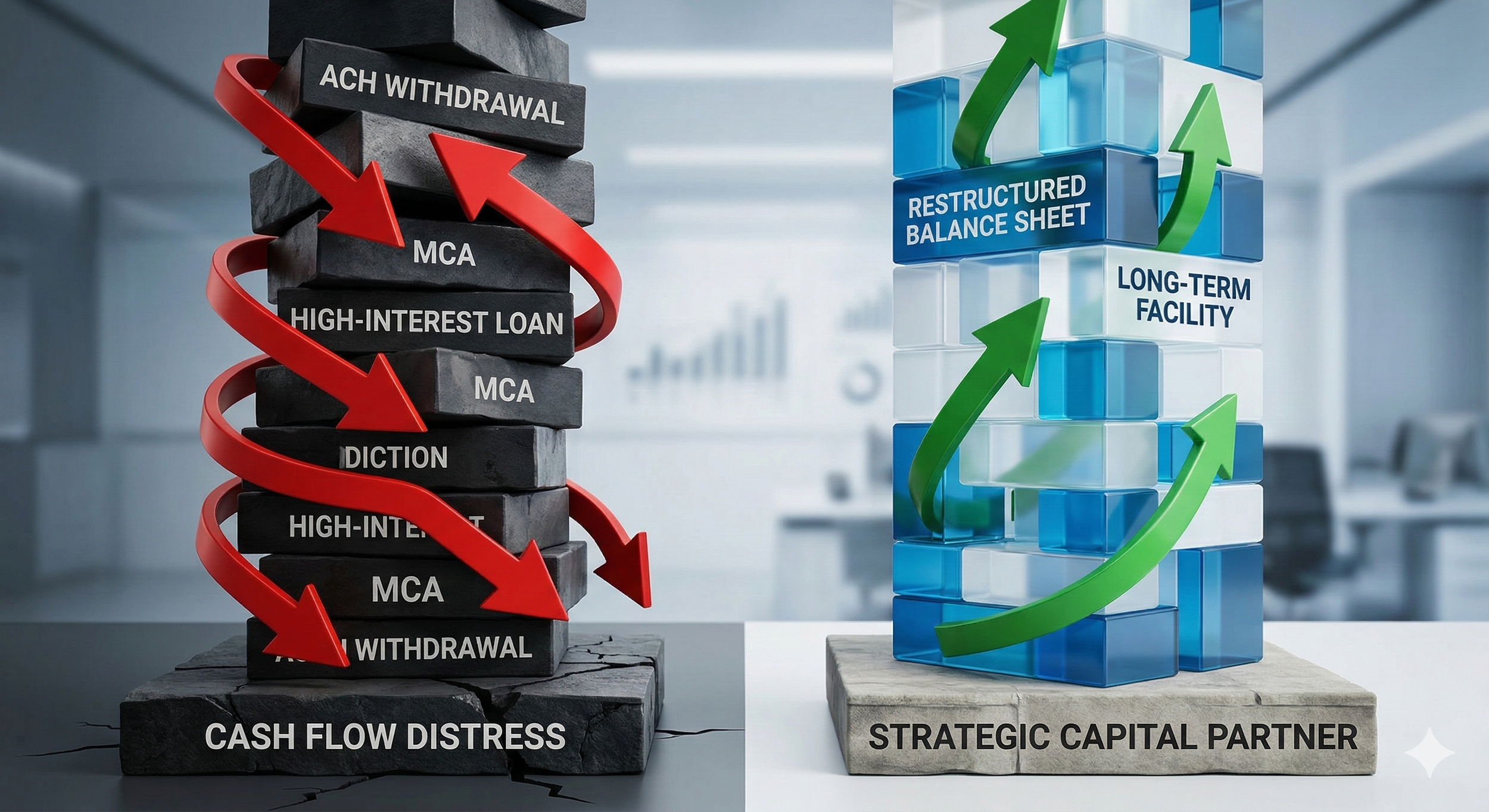
In an attempt to bridge the gap and keep operations running, many business owners turn to high-cost, short-term capital. What begins as a single merchant cash advance or a short-term, high-interest business loan quickly spirals, exponentially. As the frequent automated ACH withdrawals strip the operating account of its working capital, the business takes on another advance or financing to pay off the first, or to cover essential payroll and vendor obligations. This creates a destructive cycle known as stacked debt or transactional debt.
Stacked debt is corporate suffocation. It paralyzes operational agility and forces leadership to manage cash balances hour by hour rather than steering the strategic direction of the enterprise. The fundamental issue is that short-term debt is being used to finance long-term operational deficits, creating an unsustainable capital structure. The business is no longer operating to generate profit; it is operating solely to service its debt stack.
To survive this period of distress of the balance sheet and business cash flow, the company must undergo a radical financial transformation. The ultimate goal is to transition from this toxic, short-term debt stack into a restructured balance sheet supported by a strategic capital partner that provides a sustainable, long-term credit facility.
Achieving this requires more than just finding a new lender. Institutional capital partners will not refinance a mess. They require total transparency, rigorous financial reporting, and a clear path to profitability. Moving from crisis to stability demands an exact, methodological process to rebuild the financial infrastructure of the business from the ground up.
Diagnosing Root CauseS WITH Accurate Financials
You cannot correct a problem you cannot measure. When a business enters financial distress, the quality of its internal accounting often deteriorates simultaneously. As owners become consumed with daily survival and cash management, administrative tasks like timely reconciliations, proper expense categorization, and precise financial reporting are neglected. The result is a set of books that completely misrepresents the operational reality of the business.
Attempting to secure a new capital partner with messy, inaccurate, or outdated financials is a guaranteed failure. Lenders base their risk assessments on data. If the data is flawed, the risk is deemed too high, regardless of the intrinsic value of the underlying business. Therefore, before any restructuring or refinancing can occur, the absolute first step is a forensic diagnosis of the company's financial records.
This diagnostic phase involves stepping back from the immediate panic of the debt stack to evaluate the structural integrity of the accounting systems. It requires identifying unrecorded liabilities, misclassified assets, and phantom revenues that may be inflating the top line without contributing to actual cash flow.
Often, business owners in distress are relying on their bank balances to make decisions rather than their financial statements, simply because the statements are unreliable. This practice must end immediately. To attract an institutional credit facility, the business must demonstrate that its leadership has absolute command over the numbers. The diagnostic phase exposes the gaps in the current accounting framework and sets the stage for the rigorous reconstitution of the financial data.
Reconstituting Financial Statements to Near-GAAP Standards
Once the flaws in the existing financial records are identified, the intensive work of reconstituting the data begins. The objective is to elevate the company's financial reporting to near-GAAP standards. Generally Accepted Accounting Principles provide a standardized framework that institutional lenders, capital partners, and private equity firms require to evaluate a business accurately.
Many small to mid-sized enterprises operate on a cash basis for accounting, recording revenue when cash is received and expenses when they are paid. While this may suffice for basic tax preparation, it provides a distorted view of operational performance. Cash-basis accounting fails to align the timing of revenue generation with the costs incurred to produce that revenue. To secure a sophisticated credit facility, the financials must be transitioned to an accrual basis.
Reconstituting the financials to near-GAAP means meticulously going back through the historical records to match revenues with corresponding expenses. It involves recognizing accounts receivable when sales are made, not just when payments clear. It requires establishing accurate accounts payable records, recognizing liabilities when incurred rather than when cash leaves the building.
Furthermore, it demands proper capitalization and depreciation of assets, accurate inventory valuation methods, and the recognition of deferred revenue. This correction process strips away the distortions caused by the timing of cash flows, presenting a capital partner with a true, accurate depiction of the company's underlying operational margin and economic viability. Without this near-GAAP foundation, securing a restructured balance sheet is next to impossible.
Building the Core Financial Foundation Month by Month
A capital partner needs to understand the historical narrative of the business to underwrite its future. Providing a lender with annualized summaries is entirely insufficient when dealing with balance sheet and cash flow distress. The core financial foundation must be built out meticulously on a month-by-month basis for the last three to four years.
This comprehensive historical build-out requires the generation of the three critical financial pillars: the Income Statement, the Balance Sheet, and the Cash Flow Statement. The Income Statement must map the exact trajectory of revenue, cost of goods sold, gross margins, and operating expenses over thirty-six to forty-eight individual periods. This granular view allows a prospective lender to identify seasonality, pinpoint the exact month operational disruptions began, and track the degradation of profit margins over time.
Simultaneously, the Balance Sheet must be constructed for each corresponding month. This demonstrates the historical evolution of the company's assets, the buildup of the debt stack, and the resulting impact on retained earnings and owner equity.
Finally, the Cash Flow Statement bridges the gap between the Income Statement and the Balance Sheet, categorized distinctly into operating, investing, and financing activities. By presenting these three statements side-by-side on a continuous monthly basis, the business provides an exhaustive, transparent timeline. This level of detail proves to a capital partner that the current distress is an anomaly that can be corrected, rather than a permanent fundamental flaw in the business model.
Calculating True Profitability Through Adjusted EBITDA
Raw net income rarely reflects the true cash-generating capacity of a privately held business. To determine the actual debt-service coverage ratio (DSCR) and the enterprise value (EV), a capital partner will evaluate the company based on its EBITDA (Earnings Before Interest, Taxes, Depreciation, and Amortization). Furthermore, in a turnaround or restructuring scenario, the base EBITDA must be rigorously adjusted to reflect the core, ongoing operations of the business.
The critical step in presenting a distressed business to a lender is identifying and calculating add-backs and normalizations throughout the last three to four years on a month-by-month basis. Normalizations adjust historical financials to reflect what the expenses would have been under normal, ongoing operating conditions.
This requires a forensic line-item review of the historical Income Statements. Typical add-backs include owner compensation that exceeds standard market rates, personal expenses run through the business, one-time litigation costs, severance packages, or extraordinary losses due to discontinued product lines. Conversely, if an owner is taking below-market compensation to preserve cash, a negative adjustment must be made to reflect the true cost of management. By applying these add-backs and normalizations month-by-month across the historical data, the business reveals its Adjusted EBITDA.
This metric strips away the noise, the owner-specific perks, and the anomalous disaster events, presenting the capital partner with the true, normalized operational cash flow available to service a new, structured credit facility.
Projecting the Future with Rolling 13-Week Cash Flow Models
While historical data proves the underlying viability of the business model, capital partners fund the future, not the past. A business in distress must prove it has a definitive, executable plan to navigate out of its current cash flow crunch. This requires highly structured, defensible projections.
The first requirement is a comprehensive twelve-month projection encompassing the Income Statement, Balance Sheet, and Cash Flow Statement. These projections cannot be arbitrary hockey-stick growth charts; they must be grounded in the reconstituted historical data, adjusting for the proposed debt restructuring and defined operational turnarounds.
More critically, managing immediate distress requires a granular, tactical tool: the rolling 13-week cash flow statement. 13-weeks represents a full business quarter, offering enough visibility to anticipate shortfalls while remaining short enough to maintain high accuracy. This model requires projecting every single dollar of anticipated cash receipts against every required operational disbursement, payroll run, and debt service payment on a weekly basis.
The rolling 13-week cash flow statement is the lifeblood of a turnaround. It forces management to transition from reactive panic to proactive treasury management. It identifies exact weeks where cash balances will drop below critical thresholds, allowing leadership to stretch vendor payables, accelerate receivable collections, or draw on credit lines before a default occurs. To a capital partner, a meticulously maintained 13-week cash flow model demonstrates that management has a tight, disciplined grip on daily liquidity.
Overhauling Internal Accounting Processes and Systems
Restructuring the balance sheet and securing new capital will only provide temporary relief if the internal systems that led to the distress are left fundamentally broken. To ensure long-term stability and satisfy the ongoing reporting covenants of an institutional credit facility, the business must completely overhaul its internal accounting processes and systems.
This operational overhaul begins with the chart of accounts, which must be redesigned to support the newly implemented near-GAAP reporting standards. The business must transition away from rudimentary bookkeeping software to a robust accounting system or Enterprise Resource Planning platform capable of handling accrual accounting, complex inventory valuation, and automated reconciliation.
Furthermore, strict internal controls must be established. The business must implement a rigid month-end close process, ensuring that financials are finalized, reconciled, and reviewed within ten to fifteen days of the month's end. Processes for tracking accounts receivable must be automated, with systematic follow-ups for aging invoices to prevent bad debt accumulation. Accounts payable must be managed strategically, capturing early payment discounts where possible while optimizing days payable outstanding to preserve working capital.
Finally, there must be a permanent, unyielding separation between personal and business finances. Upgrading the accounting infrastructure guarantees that the financial visibility achieved during the turnaround process becomes the permanent standard operating procedure for the enterprise.
Assembling a Comprehensive and Institutional Credit Package
With the historical financials reconstituted, the projections built, and the internal systems overhauled, the business is ready to synthesize this data into a comprehensive credit package. This package is the definitive document presented to prospective capital partners, and its quality directly dictates the terms, rates, and structure of the eventual credit facility.
An institutional-grade credit package leaves no questions unanswered. The foundation consists of the near-GAAP reconstituted historical financials detailing the month-by-month Income Statements, Balance Sheets, and Cash Flow Statements over the past three to four years. Alongside these internal financials, the package must include the last three years+ of corporate tax returns. A reconciliation schedule should be provided to explain any variances between the near-GAAP internal books and the tax basis reporting.
The package must also provide granular visibility into working capital via detailed, current aging reports for both Accounts Receivable and Accounts Payable. A comprehensive schedule of current debt is mandatory, detailing every existing lender, the original loan amount, current principal balance, interest rate, term length, payment frequency, and collateral position.
Similarly, a current equipment schedule outlining owned assets, their appraised value, and associated liens is required. Because most commercial credit facilities require a personal guarantee from the principals, a detailed and updated Personal Financial Statement from all majority owners must be included. Finally, the package should contain specific, ancillary performance metrics and Key Performance Indicators relevant to the exact industry, providing the lender with total context regarding the operational health of the enterprise.
Securing a Restructured Balance Sheet and Capital Partner
The presentation of a flawless credit package shifts the balance of power from the short-term, predatory business debt providers back to the business owner. The goal at this stage is to identify and secure a capital partner capable of executing a comprehensive business debt restructuring.
The strategy involves utilizing the new credit facility—often structured as a combination of asset-based lending against receivables and inventory, coupled with a term loan based on the normalized cash flow—to pay off and consolidate the stacked, high-interest debt.
By terming out the business debt stack over a longer payback term, the business aggressively reduces its total monthly business debt service burden. For example, replacing a stack of merchant cash advances (MCAs) that require massive weekly (or daily) draws with a single, multi-year term loan that requires sensible monthly payments instantly injects massive liquidity back into the operating account.
This restructuring of the balance sheet fundamentally changes the trajectory of the company. It frees up working capital that can be reinvested into inventory, marketing, and operational stabilization rather than being incinerated by exorbitant interest rates. The right capital partner does not merely lend money; they provide a structural framework that allows the business to breathe, operate, and ultimately return to profitable growth.
Executing with Bernarsky Advisors
Navigating the complexities of stacked debt, reconstituting years of flawed financial data, building complex rolling cash flow models, and negotiating with institutional capital partners is an overwhelming burden. A business owner facing operational disruption must focus their finite time and energy on managing their employees, securing their clients, and stabilizing their core product or service. Expecting existing internal staff—who are often already overwhelmed by the distress—to manage a sophisticated financial restructuring is an unreasonable and dangerous strategy.
This exact process is where Bernarsky Advisors steps in. We help manages the entire spectrum of this financial turnaround. We can deploy financial experts on contract to extract the messy historical data, reconstitute the financials to near-GAAP standards, and build the required month-by-month historicals and forward-looking projections. They calculate the precise EBITDA adjustments, implement the thirteen-week rolling cash flow models, and directly overhaul the broken accounting processes that led to the crisis.
Once the financial infrastructure is rock solid, we compile an institutional credit package and we leverage our extensive network of capital partners to make attempts to secure the optimal credit facility. We assist in negotiating the terms, managing the complex underwriting process, and drive the deal to funding, effectively restructuring the balance sheet and saving the enterprise from the grip of stacked, transactional business debt.
What is the Best Way to Fix Business Debt that is causing Business Cash Flow issues?
It is NOT by stopping ACH payments.
It is NOT by taking on another business loan.
It is NOT ALWAYS a Refinancing
It is NOT by entering into a debt settlement program.
Find out the BEST strategies to get your Business back to where it was

More Business Finance and Strategy Articles: