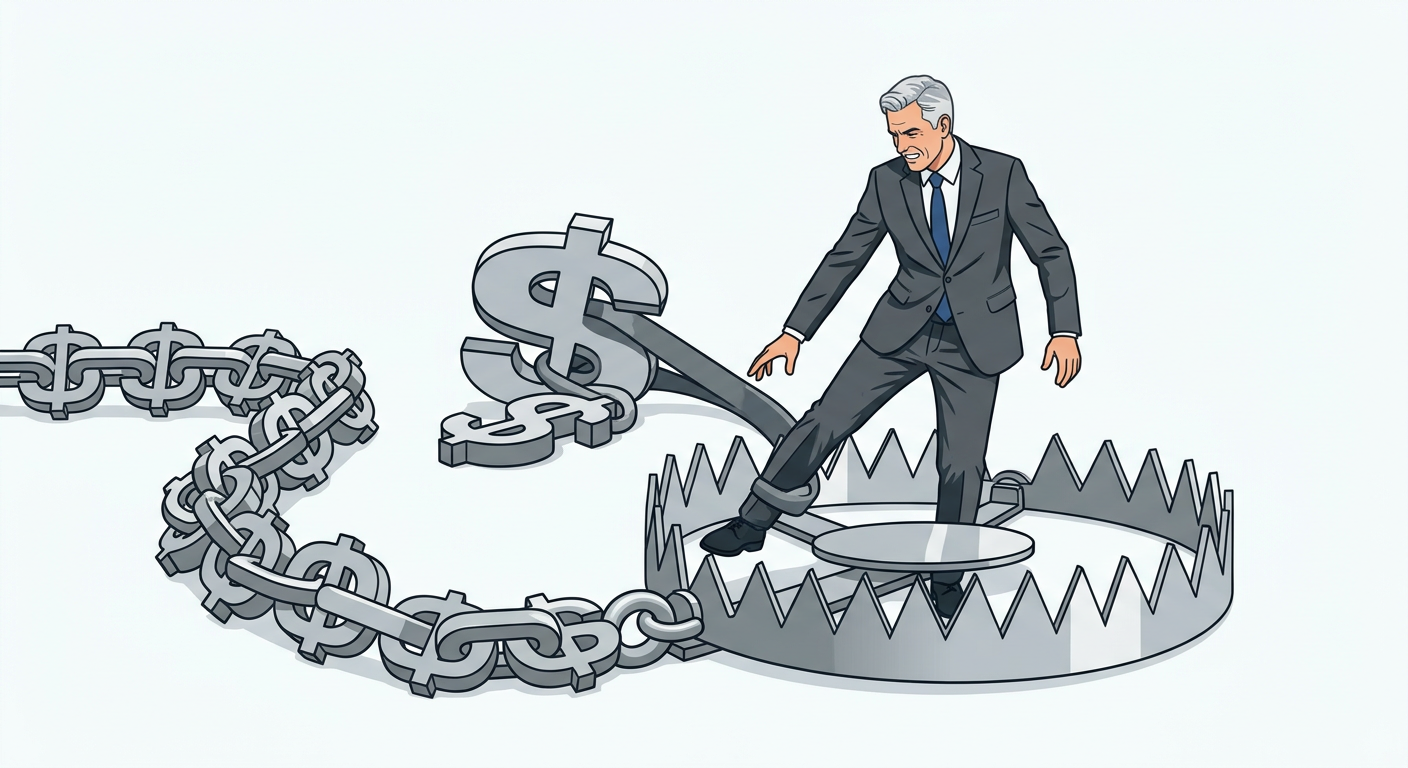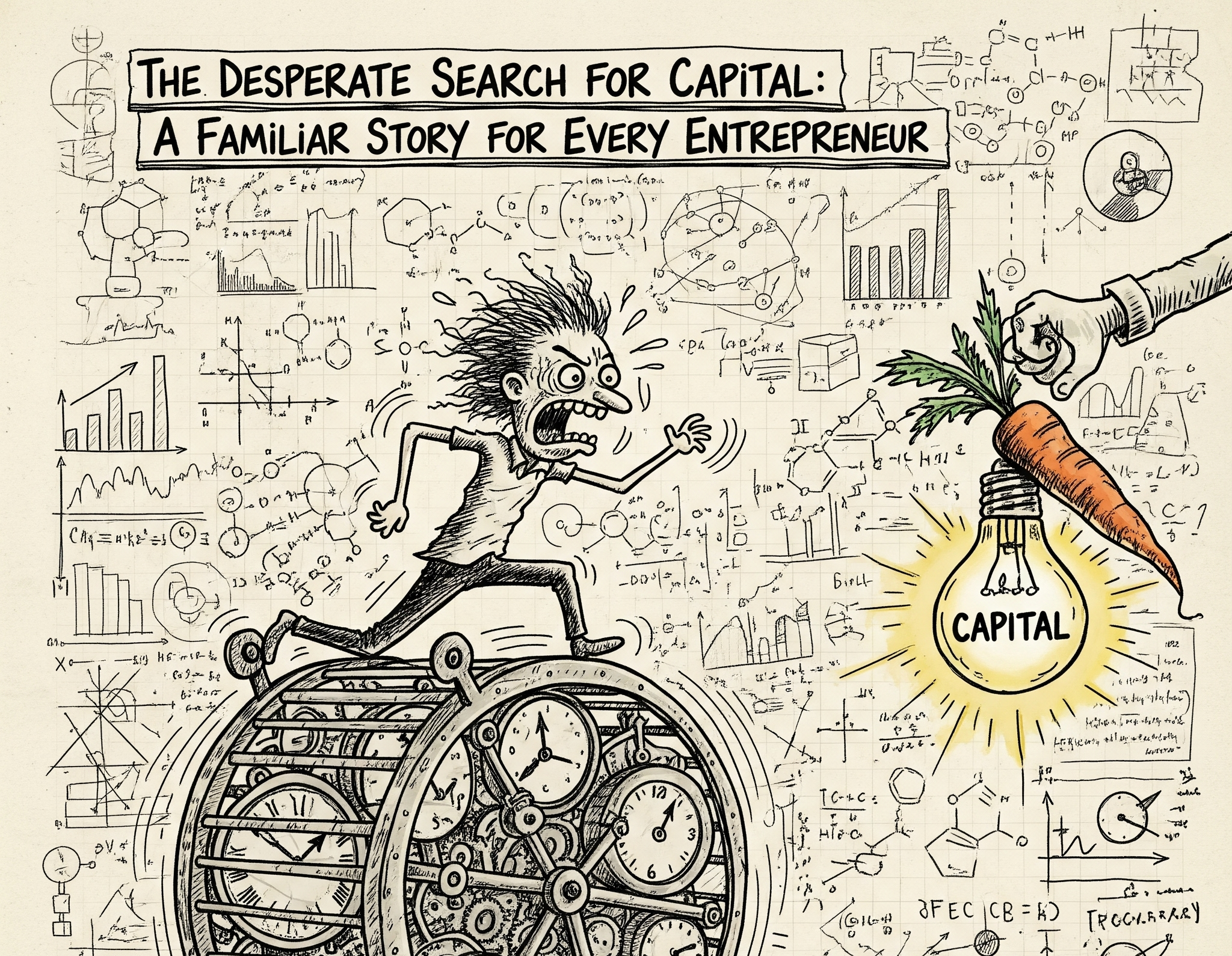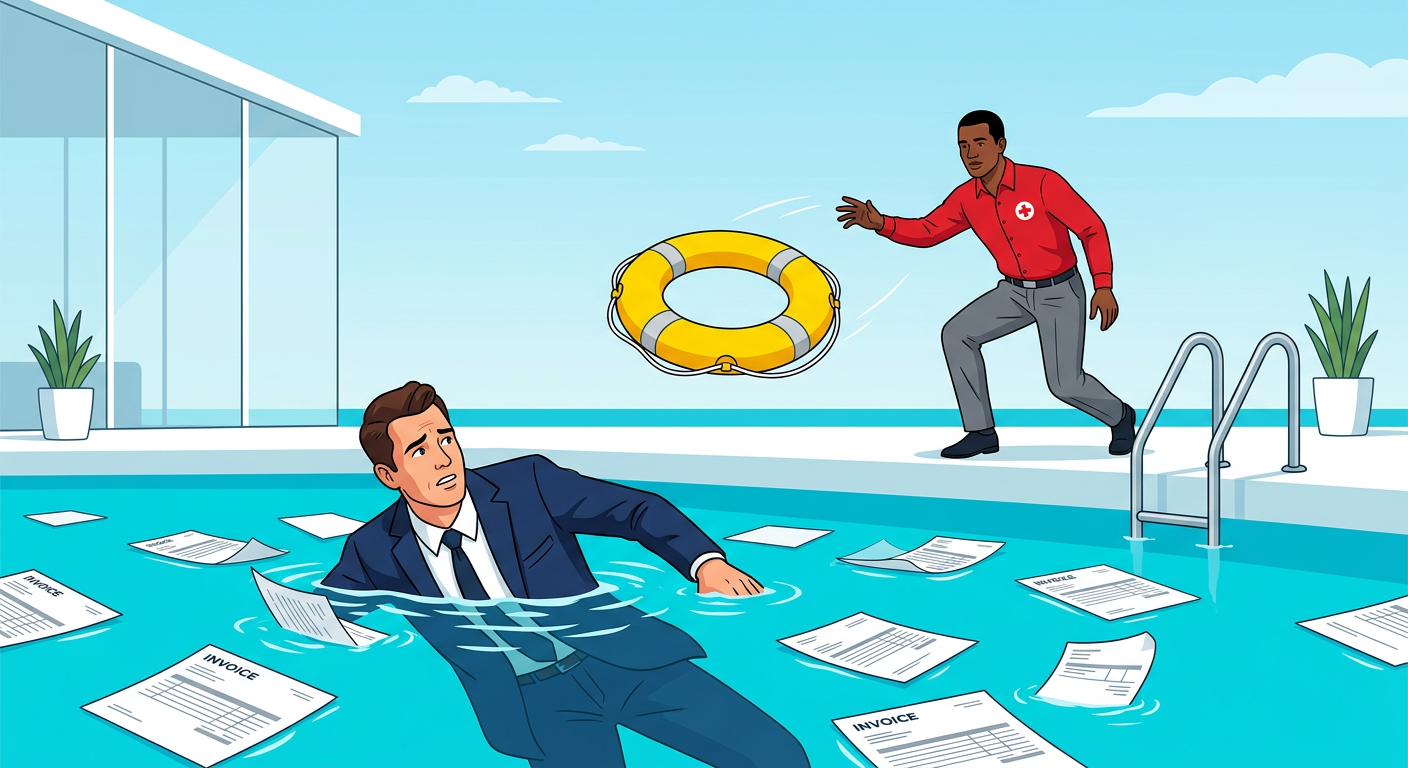
A business does not typically expire or fail from a sudden lack of revenue; it perishes from the systematic suffocation of its cash and liquidity. Of all the strategic failures that lead to corporate mortality, none is more lethal, more mathematically certain or more entirely self-inflicted than the terminal business debt spiral. This occurs when an executive leadership team, paralyzed by cash flow shortages and blinded by inaccurate accounting, begins borrowing new capital for the explicit purpose of meeting current cash flow gaps and for servicing the payments of existing debt. This is not a financing strategy; it is a rapid, managed descent into insolvency.
When an enterprise acts as a mere pass-through vehicle, collecting revenue from customers only to immediately send it to a syndicate of alternative lenders, it ceases to be a functional business. It becomes a hostage to its own capital stack.
Stopping this destructive cycle requires far more than securing another temporary bridge loan. It demands a complete architectural overhaul of the company's balance sheet, a ruthless optimization of internal operations and a total rejection of subprime or high-rate, short-term transactional finance. This comprehensive blueprint dismantles the mechanics of the business debt spiral and provides the uncompromising directives necessary to restructure your liabilities, reclaim your operating cash flow and engineer an enterprise capable of permanent market dominance.
The Anatomy of the Business Debt Stacking Phenomenon
The descent into the business debt spiral rarely begins with a massive, catastrophic financial event; it begins with a minor, misdiagnosed operational shortfall. A business encounters a temporary cash flow gap, perhaps a delayed receivable from a major client or an unexpected tax liability. Rather than diagnosing the root cause of the friction or leaning on a proactive commercial line of credit, the executive team panics. They turn to the alternative lending ecosystem, securing a Merchant Cash Advance (MCA) or a short-term, weekly-draw business loan. This capital is deployed instantly, but it introduces a toxic mechanism into the company’s treasury: the high-frequency automated clearing house (ACH) draft.
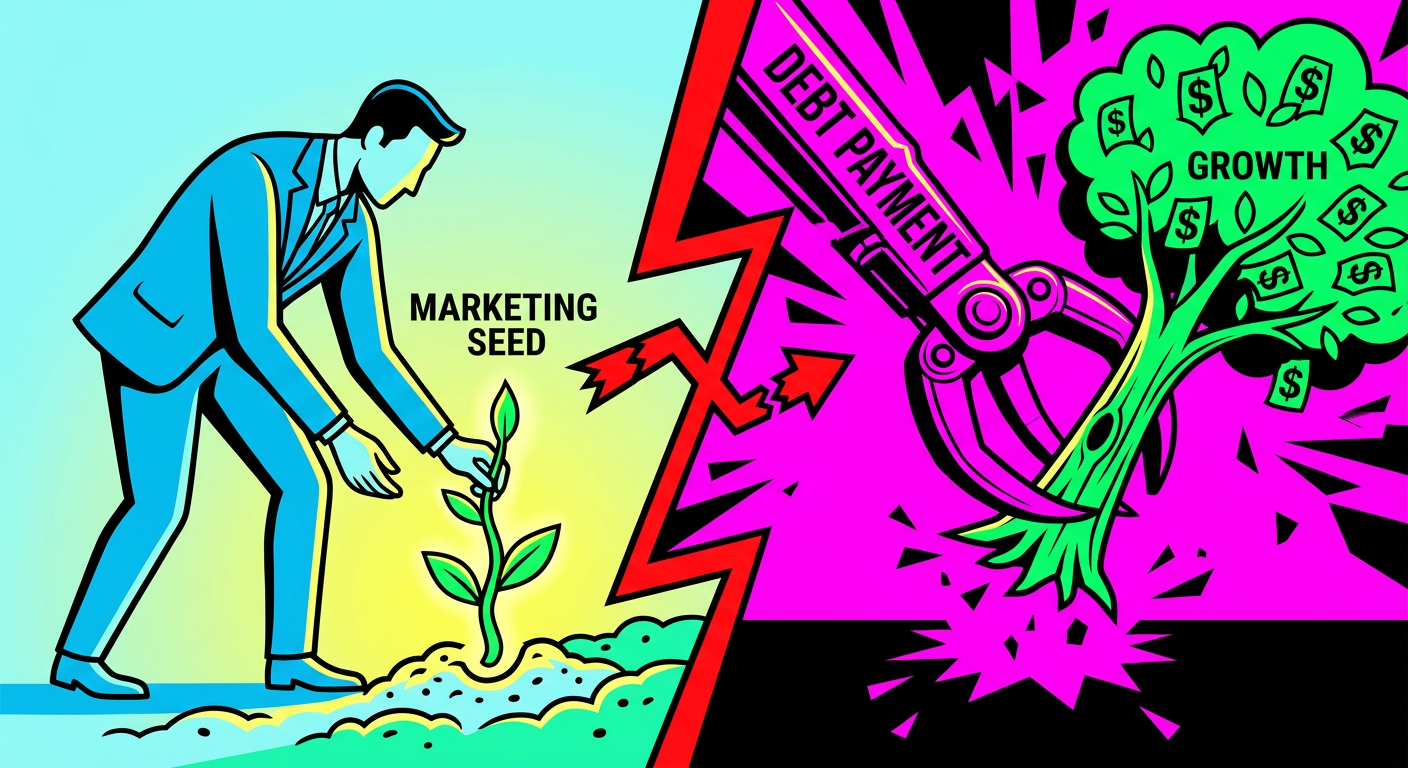
Because these short-term business debt instruments mandate aggressive weekly remittances, they immediately begin to strip the company of its baseline operating liquidity. Within weeks, the business realizes that while the initial cash infusion solved the immediate crisis, the aggressive payback structure has created a permanent structural deficit. To cover Friday's payroll while honoring the drafts of the first loan, the company takes a second short-term position.
The net funding from this second loan is rapidly incinerated by the combined business debt service of both instruments. Soon, a third position is required simply to keep the bank account from overdrawing. This practice, known as "stacking," mathematically guarantees failure. The business is no longer borrowing to invest in growth or inventory; it is borrowing simply to buy another short period of survival.
To stop this cycle, leadership must fully understand that you cannot cure a bleeding wound by administering a blood thinner. Every subsequent short-term loan accelerates the velocity of the collapse.
The Pathology of Reactive Capital Planning
The businesses most susceptible to the business debt spiral are those operating in a permanent strategic vacuum. The foundational cause of business borrowing to pay business borrowing is an absolute lack of proactive capital planning. In the arena of distressed business debt management, it is universally evident that companies relying on fast, predatory capital do so because they failed to architect a sustainable financial roadmap during periods of strength. They treat commercial finance as a reactive emergency switch to be pulled only when the corporate checking account nears zero.
When leadership waits until a cash crisis is actively unfolding to seek financing, they entirely forfeit their negotiating leverage. Traditional commercial banks and private credit providers (institutional asset-based lenders) require extensive underwriting, audited financials and a minimum of 45 to 60-days to close a facility. If you need capital by Tuesday, you are permanently locked out of the prime capital markets. You are forced to accept the punitive terms, exorbitant interest rates and draconian covenants of the high-cost, short-term business debt sector.
Eradicating the business debt spiral requires shifting from a posture of panic to a posture of precision. Capital must be secured, structured and staged months before it is actually required. By anticipating liquidity gaps through aggressive forecasting, an enterprise can shop for patient, low-cost capital from a position of absolute operational strength, rendering the fast-cash alternative lending industry entirely irrelevant to their success.
The Lethal Blindness of Interpretive Business Financials
You cannot correct a negative cash flow trajectory if you cannot accurately measure it. One of the primary catalysts for the business debt spiral is the executive team's reliance on flawed data. When an enterprise operates with unrecorded liabilities, chaotic cash-basis reporting and/or a complete lack of rigorous accounting month-end close procedures, they are navigating a storm with a broken compass.
More specifically, the danger peaks when leadership utilizes interpretive business financials reports that have been creatively adjusted, smoothed or massaged to present an artificially optimistic view of the company’s health, rather than adhering to strict, unvarnished accounting principles.
Interpretive business financials mask the lethal reality of short-term business debt. Because principal repayments on business loans are recorded on the balance sheet rather than as operational expenses on the income statement, a poorly structured profit and loss report can show massive net income while the actual bank account is being drained to zero. The executive team looks at the inflated P&L, believes the company is thriving and cannot comprehend why they constantly need to borrow more money just to cover accounts payable. This data disconnect breeds operational arrogance.
To halt the cycle, the C-suite must instantly abandon interpretive reporting and demand pristine, strictly reconciled, fully accrued financial statements. Absolute data integrity is the only mechanism that allows leadership to accurately calculate their true debt service coverage ratios and recognize the mathematical impossibility of their current capital structure before it forces them into insolvency.
Amortization Asphyxiation and the Velocity of Outbound Capital
The true destructive force of the business debt spiral is not found solely in the high interest rates; it is embedded within the brutal mathematics of the payback period structures or “amortization schedule”. Amortization dictates the velocity at which the principal balance of a loan must be returned to the lender. When a business takes short-term, high-cost financing that fully matures in 9, 12 or 18-months, it is subjecting itself to amortization asphyxiation. The sheer volume of principal that must be extracted from the company's daily operations to satisfy that short-term maturity is staggering.
Consider the unit economics: if a business borrows one million dollars on a ten-year commercial mortgage, the monthly principal burden is manageable, allowing the asset to generate a return over time. If that same million dollars is borrowed on a nine-month alternative facility, the business must generate well over one hundred thousand dollars in net-new, surplus free cash flow every single month strictly to service the debt.
For the vast majority of business enterprises, generating that level of unencumbered cash is mathematically impossible. The negative cash flow created by these poor business debt amortization structures drains the treasury, halts routine procurement and forces the exact cash flow shortages that prompt the business to borrow again. To stop the cycle, leadership must completely refuse any financing instrument that demands a payback period shorter than the time required for the funded initiative to yield a net-positive operational return.
The Structural Defect of the Maturity Mismatch
A profound violation of corporate finance doctrine occurs when a management team utilizes the wrong type of capital for the wrong type of initiative. The business debt spiral is frequently ignited by the maturity mismatch: the lethal practice of using short-term debt to finance long-term capital investments such as business growth, equipment and other hard business operating assets.
When a business uses a high-payment, twelve-month bridge loan or a business cash advance to purchase heavy manufacturing equipment, execute a commercial real estate build-out or fund a massive, multi-year software development project, they engineer a catastrophic structural flaw into their balance sheet.
Long-term assets require years of continuous, uninterrupted operation to generate the cumulative return on investment necessary to justify their acquisition. However, the short-term business debt utilized to acquire them demands immediate, aggressive principal repayment. When the short-term note comes due, the new asset has not yet produced sufficient cash to satisfy the obligation.
The business debt service must therefore be cannibalized from the operating cash flow of the existing, legacy operations. This completely paralyzes the enterprise. To break the cycle of borrowing to pay borrowing, an absolute mandate must be enforced: the duration of a liability must explicitly mirror the useful economic lifespan of the asset it is financing. Long-term assets must be funded exclusively by long-term commercial facilities, ensuring the cash generated by the asset comfortably covers its own amortized debt service.
The Inventory Quagmire and the Destruction of Internal Liquidity
For organizations that manufacture, distribute or retail physical goods, the business debt spiral is often accelerated by severe misallocations of capital within the warehouse. The "inventory quagmire" occurs when a business over-purchases raw materials or finished goods, transforming highly liquid cash into static, depreciating physical assets. Driven by flawed demand forecasting, a paralyzing fear of supply chain disruptions or the false economy of bulk-purchasing discounts, businesses routinely tie up millions of dollars in dead capital and illiquid business investment.
This trapped capital actively starves the business of the operating liquidity required to service its high-cost, short-term payback business debts. While the inventory sits on racks losing value to obsolescence, shrinkage, and carrying costs, the executive team is forced to return to the subprime business lending market to borrow the exact cash they just unnecessarily buried in their warehouse. Reclaiming this capital is mandatory to halt the borrowing cycle.
Leadership must transition immediately to precise, data-driven inventory management. They must execute granular, SKU-level turnover analysis, ruthlessly identifying slow-moving stock and liquidating it immediately, even if it requires taking a temporary loss. Maximizing the Inventory Turnover Ratio liberates trapped cash, providing a massive, zero-cost internal financing source that can be aggressively deployed to pay down toxic debt and stabilize the balance sheet.
Reclaiming Sovereignty over the Cash Conversion Cycle
The most sustainable way to stop borrowing money is to mathematically accelerate the cash your business already organically generates from collection of revenue. The heartbeat of operational liquidity is the Cash Conversion Cycle (CCC). This metric calculates the exact timeframe required for an enterprise to convert its initial cash outlay for projects or inventory and labor back into collected cash from a customer’s paid invoice. When a business is trapped in a business debt spiral, its CCC is almost always highly unmanaged and heavily fractured.
If your business extends generous 30-day payment terms to clients to win contracts, but your suppliers demand payment in fifteen days, you have engineered a massive fifteen-day (or longer) structural cash gap.
This operational gap acts as a vacuum, relentlessly sucking working capital out of the organization and forcing the company into the arms of high-frequency lenders. To stop the cycle, the executive team must violently compress the receivables window while strategically decelerating payables.
Accounts receivable must be transformed from a passive administrative task into a high-velocity collection engine. This requires revoking credit for slow-paying clients, demanding upfront deposits, and utilizing unforgiving, automated dunning protocols. Simultaneously, the procurement team must leverage their purchasing power to negotiate extended, favorable payment terms with critical vendors. By optimizing the CCC, the business generates free, internal working capital, entirely neutralizing the operational friction that drives the need for high-cost, short-term business financing.
The Command Center and the Execution of the Rolling Forecast
You cannot escape a business debt spiral by navigating blindly; you must build a financial radar system capable of predicting the terrain. A company heavily burdened by high-interest and high-payment debts must abandon static, annual budgets and implement a hyper-accurate, forward-looking tactical weapon: the rolling thirteen-week cash flow model. This model is the definitive tool used in advanced corporate turnarounds to seize control of a collapsing treasury.
Unlike a traditional income statement, the thirteen-week forecast ignores accounting timing differences and tracks the precise, physical movement of cash into and out of the corporate bank accounts and the chart of accounts across your financials. It requires the finance team to forecast receipts and disbursements on a weekly basis for a full fiscal quarter. By mapping out every single business debt draft, upcoming payroll obligation and projected customer remittance, leadership gains crystal-clear visibility into exactly when the bank account will breach zero.
If the model indicates a massive cash flow shortage in week eight, the executive team has two full months to aggressively collect aging receivables, liquidate dead inventory or negotiate a strategic payment delay with a major vendor. The rolling forecast eliminates the element of surprise, ending the state of strategic panic that constantly forces the business into taking another catastrophic short-term, high-cost business loan.
The Tactical Execution of Hostile Debt Restructuring
When a business is actively suffocating under multiple stacked loans, optimizing operations and forecasting cash is not enough; the balance sheet must be surgically altered. To stop the cycle of borrowing to pay borrowing, the enterprise must execute a ruthless, tactical debt restructuring. This requires actively confronting the current capital structure. The objective is to secure a "term-out" facility, a comprehensive commercial loan from a specialized debt consolidation fund or a transitional asset-based lender designed specifically to pay off the toxic stack of high-frequency, high-cost alternative business debt.
Executing this maneuver is incredibly complex because traditional commercial banks will uniformly reject a company with stacked subprime debt. The business must approach specialized lenders who understand distressed scenarios. The goal is to replace multiple weekly-payment advances with a single, unified commercial facility.
The critical victory is the restructuring of the amortization. By stretching the payback period from 12 or 18-months to 24, 36 or 60-months, and transitioning from weekly drafts to a single monthly payment, the velocity of the outbound principal drops exponentially. This singular, aggressive maneuver immediately stops the cash flow hemorrhage, restores baseline operational liquidity and provides the company with the breathing room necessary to execute a permanent operational turnaround and eventually begin re-investing free cash flow into operations again.
Architecting the Patient Capital Stack
The ultimate mandate for a commercial enterprise is to transition from a posture of reactive survival into a state of absolute fiscal sovereignty. Breaking the business debt spiral is only the first phase; ensuring the company never returns to the subprime market requires the deliberate architecture of a "Fortress Capital Stack." A resilient capital stack is constructed exclusively with patient capital (a capital partner) financing that features market rate SOFR interest rates, logical covenants and long amortization schedules. This type of capital respects the operational realities of the business and provides the stable liquidity engine necessary to fund aggressive market expansion.
Securing patient capital requires the enterprise to permanently elevate its internal corporate governance. Institutional lenders and prime commercial banks deploy low-cost money only after executing an exhaustive, forensic underwriting process. The business must maintain unassailable data integrity, completely eradicating inaccurate accounting and interpretive reporting. They must demonstrate a flawlessly optimized cash conversion cycle, a tightly managed inventory turnover ratio and a history of utilizing debt exclusively for long-term ROI-generating assets rather than short-term payroll emergencies.
When an executive leadership team commits to this level of uncompromising fiscal discipline, they permanently break the cycle of transactional borrowing. They transform their company from a vulnerable target bled dry by alternative lenders into an impenetrable, dominant enterprise architecturally designed to accumulate equity and command its market for generations to come.
What is the Best Way to Fix Business Debt that is causing Business Cash Flow issues?
It is NOT by stopping ACH payments.
It is NOT by taking on another business loan.
It is NOT ALWAYS a Refinancing
It is NOT by entering into a debt settlement program.
Find out the BEST strategies to get your Business back to where it was

More Business Finance and Strategy Articles: