It is the ultimate gut-punch. You pull your year-end reports, and the numbers are screaming success. Your Profit and Loss statement shows a healthy, enviable net income. Your sales team is hitting targets, and on paper, you’re killing it. But when you log into your business banking app, the reality is a cold, hard slap in the face: the balance is pathetic.
You’re staring at a screen that says you’re rich, while your actual bank account says you’re broke. You find yourself pacing the floor, demanding an answer to one question: "If I’m making so much money, where the hell is the cash?"
This isn’t just a "glitch" in the system; it’s the Phantom Profit Paradox, and it’s the silent killer of otherwise "successful" companies. You need to understand right now that profit is nothing more than an accounting theory. It’s an opinion.
Cash, on the other hand, is a physical fact. You can’t pay your employees with "profit." You can’t pay your rent with "net income." If you don’t bridge the gap between these two metrics immediately, your "profitable" business is going to go bankrupt with a smile on its face. It’s time to stop looking at your P&L through rose-colored glasses and start hunting down the cash thieves hiding in your operation.
Accrual Accounting vs. The Harsh Reality of the Bank Balance
Most of you are running your businesses on accrual accounting because that’s what your CPA told you to do. Here’s the problem: accrual accounting is a fantasy land where money is "earned" the moment you send an invoice, regardless of whether that money ever actually hits your pocket. When you finish a job and bill for $20,000, your software marks that down as profit. You celebrate. You feel like a mogul. But that $20,000 is currently a ghost. It doesn’t exist in the physical world yet.
The disconnect here is massive. Your accounting records are reflecting a future state—a hope that you will be paid—while your bank account is living in the brutal present. Business owners who manage by their income statement are essentially flying a plane while looking at a map of where they want to be, rather than the mountain they are about to crash into.
If your "earnings" are detached from your "holdings," you aren't running a business; you’re running a charity for your customers. You must stop equating "revenue" with "money" before the gap between the two swallows you whole.
Accounts Receivable: You Are Not a Bank
If your business is "profitable" but your cash is missing, look no further than your Accounts Receivable (AR). Your AR represents your money sitting in someone else’s bank account, helping them grow while you struggle to make payroll. Every time you allow a client to pay you on 30, 60, or 90-day terms, you are effectively giving them an interest-free loan. Why are you acting as a bank for people who should be paying you for your expertise?
Growth often masks this disaster. As you land bigger clients, your AR swells. Your "profit" looks legendary because you’re billing more than ever, but your cash is tied up in a stack of unpaid invoices. Every day an invoice remains outstanding is a day your business is being robbed of its liquidity.
If you don't have the stones to tighten your credit policies, demand deposits, or aggressively hunt down past-due payments, you deserve the cash crunch you're in. Profit is a hallucination until that check clears. Until then, you’re just doing free labor and calling it "success."
Inventory: Where Your Cash Goes to Rot
For those of you selling physical products, your warehouse is likely a graveyard for your cash. Inventory is a "cash sponge" that sucks the life out of your operating budget. When you buy $100,000 worth of stock, that $100,000 vanishes from your bank account instantly. But here’s the kicker: it doesn’t show up as an expense on your P&L until you sell it. This means your profit report will look glowing and healthy because that $100,000 isn't "spent" in the eyes of the IRS—it’s just sitting there as an "asset."
This is how you end up "profitable" and broke. You’ve traded liquid, usable cash for boxes of stuff sitting on shelves. If your inventory turnover is slow, or if you’re hoarding "just in case" stock, you are effectively burying your money in the backyard and wondering why you can't spend it.
You need to be ruthless. If it isn't moving, it’s killing you. Inventory isn't an asset if it prevents you from paying your bills; it’s a liability disguised as a potential sale. Flush the dead stock, stop over-ordering, and stop letting your cash rot in a warehouse.
Business Debt Obligations and the Cash Drain
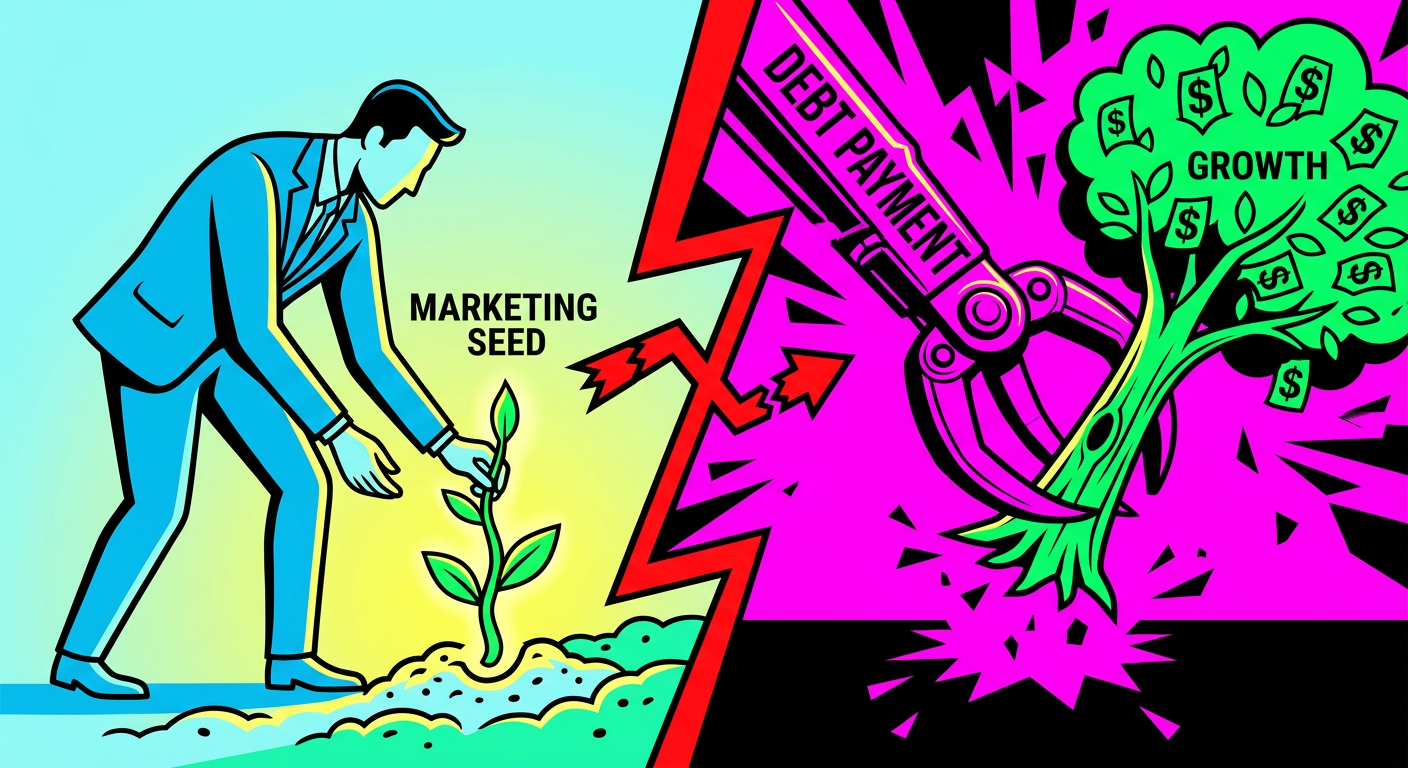
One of the most frequent reasons business owners are confused about their missing cash is a fundamental misunderstanding of the mechanics of business debt. When you make a business loan payment—whether it’s for equipment, a vehicle, or a business expansion—only the interest portion shows up on your profit and loss report. The principal repayment? That doesn't touch your P&L. It’s a balance sheet transaction that effectively disappears into the void. It shows up on a cash flow statement, but most accountants and CPA’s skip the most vital report for a business owner to be monitoring: The Cash Flow Statement
Think about the math. If you have a $10,000 monthly business debt payment obligation and $8,000 of that is principal, your Profit and Loss statement only "feels" $2,000 of that hit. You see a "profit" that includes that extra $8,000, but your bank account is $8,000 lighter than the report says it should be.
If you have multiple loans, you could be bleeding tens of thousands of dollars in cash every month that never once appears as an "expense" on your profit report. You are winning on paper and losing in the bank because you’ve forgotten that debt doesn't care about your accounting definitions—it only cares about your cash.
Tax Liabilities: The Success Penalty You Forgot to Pay
The government (Federal and State) is the most cold-blooded partner you will ever have. They don’t care if you have the cash to pay them; they only care about your taxable profit. If you’ve had a "profitable" year on paper, you have triggered a tax liability. Many business owners see a high profit number, assume that money is theirs to keep, and reinvest it or spend it. Then, April rolls around, or a quarterly estimate comes due, and they are blindsided by a massive bill they can’t afford to pay.
This is the ultimate trap. You’ve used your "profit" to buy new equipment or hire a new manager, but the IRS doesn't recognize those as immediate offsets to your tax bill. You are being taxed on money you’ve already spent or money you haven't even collected from your customers yet. If you aren't siphoning off a percentage of every single dollar that enters your business into a separate tax account, you are playing a dangerous game of chicken with the feds—and you will lose.
The High Cost of Rapid Growth: Growing Into the Ground
Growth is often the reason businesses die. It sounds counterintuitive, but "growing broke" is a very real, very common phenomenon. To scale, you need more people, more space, more software, and more materials. These costs hit your bank account now. However, the revenue from that growth won't hit your account until later.
If you double your sales, you might need to triple your upfront spending to fulfill those orders. If your customers are on 30-day terms, you are financing 60 to 90 days of increased payroll and overhead with the cash you had from your smaller, older operations. The faster you grow, the faster you burn through your reserves.
You can be the most profitable company in your city and still go under because you ran out of the cash needed to fuel the engine. Growth is a beast that eats cash for breakfast; if you don't have a massive pile of it ready, your "success" will be your downfall.
Owner Draws: Your Lifestyle Is Killing Your Company
Let’s be honest: many of you are your own worst enemy. In an LLC, INC or sole proprietorship, your personal draws and distributions usually don’t show up on the P&L as an expense. You look at your profit report and see that you made $15,000 this month. You think, "Great! I’m doing well!" But you’ve been swiping the business card for personal dinners, taking out $5,000 for your mortgage, and another $3,000 for a vacation.
Because those draws aren't "expenses," they don't lower your profit. You can show a massive profit while your bank account is empty because you personally spent all the cash. You are cannibalizing your own business. If you don't have a strict, disciplined salary for yourself—and if you don't treat your business’s money with more respect than your own—you will never solve the mystery of the missing cash. Stop treating your business like an ATM and start treating it like a separate entity that needs to breathe.
Capital Expenditures: Buying Your Way to Insolvency
Just like business debt principal, "Capital Expenditures" are a major source of cash disappearance. If you drop $50,000 on a new piece of machinery, your profit doesn't drop by $50,000. Through the "magic" of depreciation, you might only show a $5,000 expense this year. On paper, you still have $45,000 of that "profit." In reality, that money left the building the second you signed the purchase agreement.
This creates a massive "profit" that isn't backed by a single cent of liquidity. You’ve traded your operating capital for a fixed asset. While that asset might help you make more money in the long run, it does absolutely nothing for you when you need to pay your electric bill today. If you are constantly upgrading equipment or buying new vehicles without a clear cash-flow projection, you are effectively trading your business’s lifeblood for shiny new toys.
Strategies to Stop the Bleeding and Take Control
If you’re tired of being "paper rich" and "bank account poor," it’s time to stop whining and start managing. You need to fire any accountant who only gives you a P&L and start demanding a Statement of Cash Flows. You need to know exactly where every dollar is hiding.
Are you over-inventoried? Are your customers playing you for a fool with late payments? Are you spending too much on personal "extras"?
Stop the madness today by implementing these non-negotiable rules:
● Demand Deposits: Never start work without cash in hand. If they won't pay a deposit, they aren't a client; they're a risk.
● Kill the Terms: Move your customers to "Due on Receipt." If they want 30 days, charge them a premium for the "loan" you're giving them.
● Lean Out Inventory: If it’s been on the shelf for more than 90 days, sell it at cost and get the cash back.
● Tax Discipline: Open a separate savings account today. Every time you get a payment, move 25% of the profit portion into that account. Don't touch it.
Your business is a machine, and cash flow is the oil. Profit is just a sticker on the side of the machine that says "Fast." The sticker doesn't matter if the engine is seized up. Stop obsessing over your "earnings" and start obsessing over your "liquidity." If you don't, you’re just one bad month away from realizing that your profitable business was actually a hollow shell.
What is the Best Way to Fix Business Debt that is causing Business Cash Flow issues?
It is NOT by stopping ACH payments.
It is NOT by taking on another business loan.
It is NOT ALWAYS a Refinancing
It is NOT by entering into a debt settlement program.
Find out the BEST strategies to get your Business back to where it was

More Business Finance and Strategy Articles: