
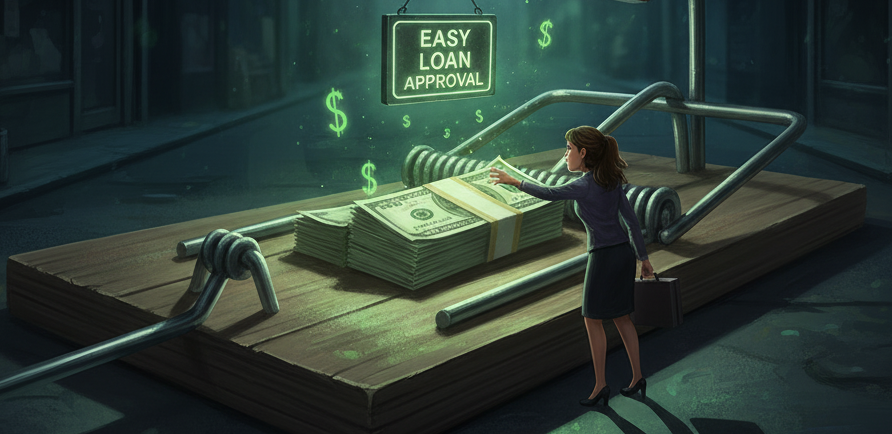



The Illusion of Short-Term Business Debt

The Illusion of Short-Term Business Debt

Running a business, especially a small or medium-sized one, often feels like a constant juggling act.

You're balancing cash flow, managing inventory, meeting payroll, and planning for future growth. In this high-wire act, a sudden cash shortfall can feel like a devastating blow. A client pays late, a key piece of equipment breaks down, or a golden opportunity for a bulk purchase arises—and you don't have the cash to seize it.

This is precisely where short-term business debt enters the picture. It promises a swift solution, a quick fix to an immediate problem. It's the financial equivalent of a band-aid: fast, easy to apply, and seemingly effective.

However, what many business owners don't realize is that this quick fix can lead to a long-term problem: the short-term business debt trap.

This trap isn't just a metaphor; it's a very real cycle of borrowing to pay off existing debt, a cycle that can choke a business's growth and even lead to its demise.

This article is a guide to understanding what the short-term debt trap is, how to identify if you're in it, and most importantly, how to escape it. We'll delve into the types of short-term debt, the warning signs of a debt spiral, and actionable strategies to not only get out of debt but also to build a more resilient financial foundation for your business.

Business Financial Stress and Its Profound Impact on Entrepreneurial Decision-Making

Business Financial Stress and Its Profound Impact on Entrepreneurial Decision-Making

Running a small business is often romanticized as a pursuit of passion and innovation, but beneath the surface lies a complex reality filled with significant challenges.

Among the most formidable of these is financial stress, a silent yet potent force that can undermine a business owner's most crucial asset: their ability to make sound, strategic decisions.

This article explores the deep-seated ways financial pressures can hijack your judgment, along with actionable strategies to fortify your mental and financial resilience.

Business Cash Flow Help, Talk to Your Creditors

Business Cash Flow Help, Talk to Your Creditors

Every small business owner knows the feeling.

It's that gut-wrenching moment when you look at your bank balance and realize it's lower than you'd like.

The invoices are piling up, and the money isn't coming in fast enough.

This isn't just a hypothetical scenario; it's a common, and often stressful, reality for many entrepreneurs.

A business, no matter how profitable it is on paper, can't survive without a healthy cash flow. It's the lifeblood of your operation, covering everything from payroll to purchasing inventory.

When it's tight, it can feel like you're in a financial pressure cooker. But here’s the thing: you're not alone, and there are proactive steps you can take.

One of the most powerful, yet often overlooked, strategies is to open a dialogue with your creditors.

This article will walk you through why, how, and when you should talk to the people you owe money to, transforming a potential crisis into a manageable situation.

Bad Business Financing Eats Profits

Bad Business Financing Eats Profits

As a small business owner, you're the engine of your enterprise. You're the visionary, the strategist, the marketer, and often, the accountant. You understand that profitability is the lifeblood of your company. You watch your sales numbers, scrutinize your expenses, and tirelessly work to increase your margins.

But what if a hidden threat is silently gnawing at your profits, a threat you might not even realize exists? This threat is bad business financing. It's the high-interest loan you took out in a moment of desperation, the predatory line of credit that seemed too good to be true, the convoluted equipment lease that's costing you more than the asset itself.

These seemingly innocuous financial decisions can act like a slow-moving poison, siphoning off your hard-earned revenue and leaving you with less to invest in growth, less to pay your team, and ultimately, less to put in your own pocket.

The allure of quick cash can be strong. A new opportunity arises, a critical piece of equipment breaks down, or a sudden cash flow crunch threatens to derail your operations. In these moments, the first offer that comes your way, regardless of its terms, can look like a lifeline. But this is where the danger lies.

A bad financing deal doesn't just cost you money in the short term; it creates a long-term drain on your resources. It's a weight that gets heavier with each passing month, forcing you to constantly run faster just to stay in the same place.

This article will be your guide to understanding the various ways bad business financing can eat your profits, and more importantly, how you can avoid these pitfalls and secure a financial foundation that truly supports your business's growth.

We will delve into the different types of bad financing, the warning signs to look out for, and the strategic decisions you can make to ensure your financing works for you, not against you.

Unseen Threats in Small Business Financing

Unseen Threats in Small Business Financing

Your business is more than just a company; it's a testament to your relentless effort and unwavering vision.

You've fought through countless challenges, from market downturns to unforeseen emergencies.

But there’s a new, more insidious threat lurking in the shadows of the financial world—one that preys on your moments of vulnerability.

This isn't a simple risk; it’s a sophisticated attack.

When cash flow tightens or you face an unexpected setback, predatory lenders see it as an open invitation to seize your hard-earned assets and ultimately dismantle your dream.

Their methods are subtle, their promises are slick, and their contracts are designed to be a financial trap.

Understanding this threat is the first step to defending yourself and securing your business's future.

The time for passive learning is over. This is a call to arms for every business owner.

Short-term Business Debt Trap and How to Refinance

Short-term Business Debt Trap and How to Refinance

Short-term Business debt isn't a long-term solution; it's a financial chokehold.

Think about your daily or weekly payments.

They don’t just happen; they actively steal from your business's future.

You’re constantly scrambling, watching every dollar you earn get siphoned off the moment it hits your account.

This isn't a business; it's a treadmill. You’re running faster and faster just to stay in the same place.

And what about the interest?

That small percentage on a merchant cash advance or line of credit is a financial mirage. When you calculate the true Annual Percentage Rate (APR), you'll see a number so high it will make your head spin.

This is money that could have been used for a new marketing campaign, a much-needed piece of equipment, or even an emergency fund.

Instead, it’s gone. You're not just paying for money; you’re paying a premium for your own financial instability. This constant stress isn’t just bad for your business; it's eating away at your health, your focus, and your ability to lead. You need to act, and you need to act now.

The Shadow Economy of Short-Term Business Finance

The Shadow Economy of Short-Term Business Finance

This guide provides education and awareness about the common practices in the high-cost and short-term business lending market.  

It sheds light on complex terms like "factor rates" that can obscure very high Annual Percentage Rates (APRs) and details the risks associated with certain contractual clauses, such as Confessions of Judgment and Uniform Commercial Code (UCC) blanket liens.  

It also explains the potential conflicts of interest with some funding brokers, who may be motivated by high commissions to recommend expensive debt over more affordable options like SBA loans and other long-term lenders in the private business credit marketplace. 

The consequences of taking on high-cost debt can be severe, leading to cash flow problems, operational strain, and intense stress for business owners.  

These challenges are often compounded by a regulatory environment that offers fewer protections for business loans than for consumer loans. 

This guide is a resource for building a stronger, more transparent financial future.  

For business owners, it offers a toolkit for financial literacy and due diligence.  

Through education and constructive solutions, we can empower small businesses to secure the reasonable and helpful capital they need to thrive.

Business Debt Settlement and Why It's a Dangerous Game for Your Company

Business Debt Settlement and Why It's a Dangerous Game for Your Company

Your phone rings. It’s a creditor, again. Your inbox is full of past-due notices. Panic sets in. In this moment of pure desperation, a seemingly perfect solution appears: a business debt settlement company.

This isn't just a friendly article post; this is a warning.

We're pulling back the curtain on the lies these companies tell, exposing their toxic business model, and showing you exactly how they are setting your business up for a catastrophic failure.

They promise to make your problems disappear, to negotiate a clean slate with your creditors for a fraction of what you owe.

But what they don’t tell you is that this "solution" is often a potential road, or more like a highway, to financial ruin.

This article will explore why business debt settlement companies are, in most cases, a terrible choice for a small business owner struggling with financial issues.

We'll break down their tactics, expose their often-predatory practices, and reveal the real dangers that lie beneath their promises.

What to Do When Your Business Can't Afford Its Debt Payments

What to Do When Your Business Can't Afford Its Debt Payments

If your business can't afford its debt payments, you're not facing a "challenge"—you're in a crisis.

This isn't a time for wishful thinking or hoping things get better.

It’s a time to face the brutal reality and take immediate, decisive action.

The walls are closing in, and every second you waste is another step toward failure.

This isn't about feeling bad; it's about getting tough, getting smart, and fighting for your business's survival.

Here’s a no-nonsense guide to what you must do right now.

Negative Business Cash Flow and How to Win the Fight

Negative Business Cash Flow and How to Win the Fight

Let's cut the pleasantries.

If you're reading this, you know the game.

You've felt the cold dread of an empty bank account and seen the shadow of an overdue invoice.

You know the term "negative cash flow" isn't just some abstract accounting term — it's the financial blood leaking from your business.

And circling that open wound are a pack of predatory lenders ready to tear you apart.

This isn't a guide to holding hands and singing "Kumbaya" with your business financial problems.

This is the start of a battle plan.

A no-BS, aggressive playbook to stop the bleeding, reclaim your territory, and send those short-term, greedy creditors packing and exchange them for longer term lenders.

Your survival depends on your willingness to confront this crisis head-on.

There is no middle ground, only fight or failure.

It's time to get your hands dirty, take control, and ensure your business lives to see another day.

Business Lenders Saying NO to your Applications?

Business Lenders Saying NO to your Applications?

It’s a disheartening moment for any small business owner: receiving that dreaded notification that your loan application has been declined.

You’ve poured your heart and soul into your venture, meticulously crafted your business plan, and envisioned the growth that access to capital would unlock.

Yet, despite your efforts and optimism, the answer from the lender is a firm “no.”

This rejection can feel like a personal blow, leaving you questioning your business viability and future prospects.

However, it’s crucial to remember that loan denial is a common experience for small businesses, and understanding the reasons behind it is the first step toward finding a remedy and ultimately securing the funding you need.

This article will delve into the multifaceted world of business lending, exploring the key factors that lenders scrutinize and offering practical strategies to navigate the challenges and turn those “no’s” into a resounding “yes” down the line.

We will break down the common pitfalls that lead to loan application rejections and provide you with a roadmap to strengthen your position and access the capital that fuels small business success.

Emerging from Business Debt and Cash Flow Distress

Emerging from Business Debt and Cash Flow Distress

Running a small business is often a labor of love, filled with passion, dedication, and the constant pursuit of a dream.

However, the realities of the business world can sometimes present significant hurdles, and among the most challenging are navigating business debt and the stress of consistent cash flow distress.

Recognizing that your business is facing these difficulties is the crucial first step on the path to recovery.

It requires courage, honesty, and a willingness to confront the situation directly, rather than allowing it to fester and potentially worsen.

Many small business owners, driven by optimism and a desire to persevere, might initially downplay or ignore the warning signs of mounting debt or dwindling cash reserves.

This denial can be a significant obstacle to finding effective solutions.

Signs That Business Debt is a Problem

Signs That Business Debt is a Problem

Business Debt is often an unavoidable part of running a business.

Whether it's a loan to get started, a line of credit to manage cash flow, or financing for new equipment, taking on business debt can be a valuable tool for growth and sustainability.

However, like any tool, it can become dangerous and harmful if not handled correctly.

Understanding when your business debt is transitioning from a helpful resource to a significant problem is crucial for the long-term health and survival of your enterprise.

This article will explore ten key signs that indicate your business debt might be spiraling out of control, providing small business owners with the knowledge to recognize these red flags and take proactive steps.

Recognizing these issues early can make all the difference in steering your business towards a more secure financial future.

Ignoring these signs can lead to increasing financial strain, hindering your ability to invest, grow, and even maintain daily operations.

Let’s delve into the indicators that suggest your business debt is becoming a cause for concern.

Identifying Inefficiencies, Are Your Operations Bleeding Cash?

Identifying Inefficiencies, Are Your Operations Bleeding Cash?

Running a small business is a challenging yet rewarding endeavor.

You pour your heart, soul, and significant financial resources into building something you believe in.

You navigate the complexities of the market, strive to provide exceptional products or services, and work tirelessly to cultivate a loyal customer base.

However, even with the best intentions and a dedicated team, subtle yet significant inefficiencies can creep into your operations, slowly but surely draining your profits and hindering your growth potential.

These inefficiencies, much like a hidden leak, can silently bleed your business dry, leaving you wondering why your bottom line isn't reflecting the hard work you're putting in.

This article is designed specifically for you, the small business owner, to shed light on the often-overlooked areas where inefficiencies can thrive.

We will explore ten key aspects of your business operations, providing you with practical insights and actionable steps to identify and address these hidden drains on your cash flow.

By taking a proactive approach to uncovering and eliminating these inefficiencies, you can plug those leaks, strengthen your financial foundation, and pave the way for sustainable success.

From Operating Losses to Gains, Becoming a Profitable Business

From Operating Losses to Gains, Becoming a Profitable Business

Every small business owner understands the thrill of starting something new – the passion, the vision, and the dedication poured into bringing an idea to life.

However, the path to sustained success is rarely a straight line.

Many entrepreneurs, despite their unwavering commitment, find themselves grappling with a common and often disheartening challenge: operating losses.

The early days of a business are often characterized by significant investment, a steep learning curve, and the inherent volatility of a nascent market presence.

It’s a period where expenses often outpace revenue, leading to red ink on the balance sheet

This can be a source of immense stress, raising questions about viability and the future of the venture.

Yet, facing operating losses is not an automatic death knell for a small business.

In fact, it's a phase that many successful companies have navigated.

The critical distinction lies in how a business owner identifies, understands, and strategically addresses these losses.

This article is a comprehensive guide for small business owners seeking to transition from a period of financial deficit to sustained profitability.

The Private Credit and Growth Capital Marketplace for Small and Medium-sized Businesses

The Private Credit and Growth Capital Marketplace for Small and Medium-sized Businesses

For the ambitious small or medium-sized business owner, there comes a point where growth feels both tantalizingly close and frustratingly out of reach.

You have the orders, the strategy, and the team, but the capital required to seize the opportunity exceeds the rigid parameters of traditional bank lending.

This is the moment many entrepreneurs discover the world of private credit and growth capital... a sophisticated, dynamic, and demanding marketplace that can provide the fuel for transformational growth, but only for those who are meticulously prepared.

This article will pull back the curtain on this exclusive world, revealing what these capital providers look for, what they demand in return, and how you can position your company to successfully secure the funding you need to reach the next level.

Are Your Business Debt Payments Too High?

Are Your Business Debt Payments Too High?

As a small business owner, you wear countless hats.

You are the CEO, the head of marketing, the chief custodian, and often, the lead worrier.

One of the heaviest burdens to carry is business debt.

While business debt is a powerful and often necessary tool for growth—funding new equipment, expanding your location, or managing gaps in cash flow—it can quickly transform from a helpful partner into a crushing weight.

When business debt payments become unmanageable, they don’t just strain your finances; they suffocate your opportunities, drain your energy, and put the very survival of your business at risk.

This article is a guide to help you diagnose the health of your business’s debt load, understand its true cost, and chart a course back to financial stability and peace of mind.

10 Business Cash Flow Killers

10 Business Cash Flow Killers

Profit is vanity, Cash is sanity. This old business adage has never been more relevant.

As a small business owner, you’re likely obsessed with your profit and loss statement, celebrating the black ink at the bottom of the page.

But a profitable business can struggle with obtaining reasonable financing, keeping liquidity and operations can suffer as a result.

How? The answer lies in cash flow—the actual movement of money into and out of your business.

It is the oxygen that keeps your operations alive, allowing you to make payroll, pay suppliers, and invest in growth.

While a sudden crisis can certainly threaten your business, the more common and insidious threats are the silent killers—the slow leaks and unnoticed habits that drain your cash reserves over time.

These issues don't announce themselves with a bang; they creep in quietly, often disguised as normal business operations, until one day you’re staring at a bank balance that can’t cover next payroll or next month’s expenses.

Understanding and neutralizing these threats is not just good financial management; it is fundamental to survival and long-term success.

This article unmasks the ten most dangerous silent killers of cash flow and provides the strategies you need to protect the lifeblood of your business.

Beware of Business Funding Brokers: They Only Care About Commissions

Beware of Business Funding Brokers: They Only Care About Commissions

Are you sick of the persistent and a perpetual hunt for business capital?

Whether it’s to cover payroll during a slow season, purchase new equipment to meet growing demand or fund a strategic expansion, the need for financing is a universal chapter in the entrepreneurial story.

In this high-stakes search, it’s easy to feel overwhelmed and isolated.

The pressure mounts, the clock ticks, and when a solution appears that promises speed and simplicity, it can feel like a lifeline.

This is the world where the business funding broker operates, often positioning themselves as a knowledgeable guide through the complex landscape of business lending.

However, behind the curtain of convenience lies a fundamental conflict of interest that every business owner must understand.

Their primary motivation is not your success, but their commission.

This article will pull back that curtain, expose the hidden mechanics of the business funding brokerage industry, and empower you to take back control of your company’s financing.

Advanced Business Financial Strategy: Beyond the Balance Sheet

Advanced Business Financial Strategy: Beyond the Balance Sheet

As a small business owner, you are the master of your craft.

You understand your customers, your product, and your market inside and out.

But what about the numbers?

For many entrepreneurs, the financial side of the business can feel like a necessary evil—a labyrinth of spreadsheets, tax forms, and accounting jargon that exists primarily to satisfy the bank and the IRS.

The balance sheet, the income statement… these are often viewed as historical records, a rearview mirror look at where you’ve been.

This perspective, while common, is dangerously limiting.

Your financial data is not just a record of the past; it is the most powerful tool you have for shaping the future.

It’s a compass, a blueprint, and a strategic weapon all rolled into one.